AI chatbots, Japan's election and the Communist Party: why AI recommends what it can read
A Stanford and Waseda study found five AI models converged on Japan's Communist Party for left-leaning test voters, while big newspapers blocked AI crawlers and the party's paper stayed open. What it proves, what it doesn't, and how to check your site.
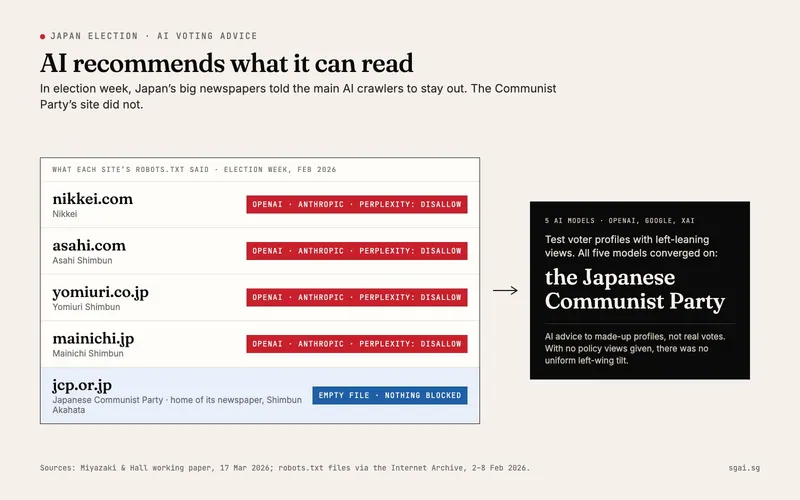
In the final week of Japan’s February 2026 election, researchers asked five artificial intelligence (AI) models which party a voter should back, using tens of thousands of made-up voter profiles. 12 For profiles with left-leaning views, all five converged on the Japanese Communist Party. 3
The researchers trace that to what the models could read. The party’s own newspaper website was fully open, while Japan’s big newspapers blocked AI crawlers. 4 This is not a story about how Japan voted: the study did not measure real votes, and in the actual election the party’s seats fell from eight to four. 56
Our read: the same logic applies when a customer asks an AI assistant to recommend a business. If your website shuts out AI search crawlers, or keeps prices and opening hours only in pictures, the assistant will tend to name someone it can read. Search and training are separate choices, and you can make them separately.
What Japan’s election study actually found
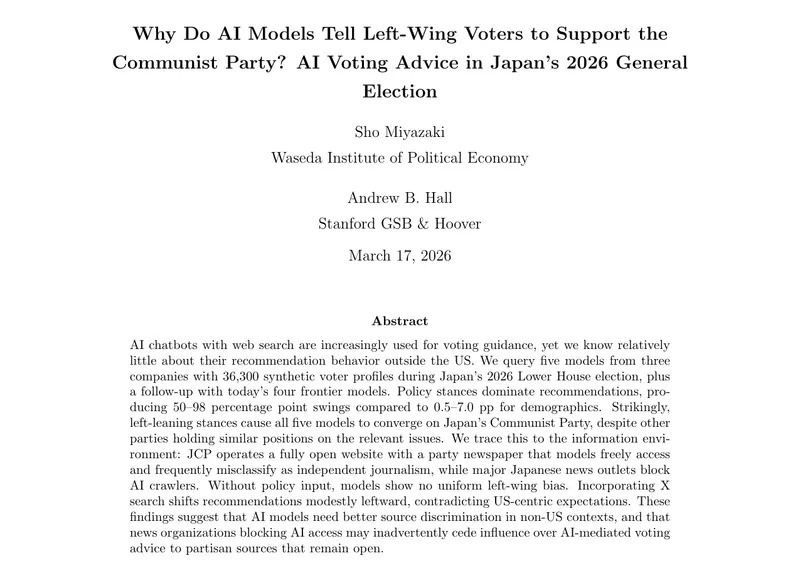
Sho Miyazaki of Waseda and Stanford’s Andrew B. Hall dated their working paper 17 March 2026. 7 It is a working paper, not a journal article, and its data and code are public. 89 Treat its findings as research to examine, not a settled explanation of how all assistants behave.
The researchers tested five models—the software behind AI assistants—from OpenAI, Google and xAI. They used 36,300 made-up voter profiles between 2 and 8 February, with web search switched on. 1102 That means thousands of controlled requests, not interviews with voters.
Each Japanese-language request asked the model to recommend a party. For profiles expressing left-leaning policy views, all five models converged on the Japanese Communist Party (JCP), despite other parties holding similar positions. 113
But without policy views, there was no uniform left-wing tilt. Three of the five models defaulted to the governing Liberal Democratic Party (LDP). 1213 The finding was about particular prompts, not a blanket political preference.
The paper explicitly “does not measure downstream effects on actual voting behavior”. 5 In the real election, the JCP’s seats fell from eight to four in the 465-seat chamber. 614 AI advice is not how people voted.
What happened, when
| Date | What happened | Why it matters |
|---|---|---|
| 4 June 2025 | Newspaper association called for consent to use news | Publishers had stated their position |
| 2–8 February 2026 | Researchers queried the models | Election-week behaviour, not today’s models |
| 8 February 2026 | Japan held its Lower House election | Actual results are separate from AI advice |
| 17 March 2026 | Working paper dated; four newer models also tested | Research followed the election |
| 31 March 2026 | Stanford published its summary | Explained the proposed access problem |
| 16 November 2026 | Stanford published the Hall–Sun discussion | Brought the issue back into focus |
| 21 November 2026 | We re-read the robots.txt files and compared them with election-week copies | Avoids treating today’s settings as February’s |
What this means for you: Treat the study as a warning about uneven information, not evidence that AI changed an election.
What the chatbots could read in election week
The authors trace the pattern to the information environment. The JCP’s website was fully open, while major Japanese newspapers restricted AI access. Models frequently treated its newspaper, Shimbun Akahata, as independent journalism. 4
Hall, the paper’s co-author, put it more bluntly at a Stanford event in November: “It's a kind of a big deal, and it's completely open. And so the chatbots can't access Nikkei, they can't access the sort of like mainstream Japanese media, but they can access the Communist Party's news, and then that's what they tend to bring back to the user.” 20 The study’s own data is more mixed, as we show below.
The authors also acknowledge that Akahata presents itself as journalism. The boundary between news and party communication is genuinely blurred, rather than a simple labelling mistake. 2122 For business readers, the lesson is to check who stands behind a cited source.
A crawler is a program sent to collect web pages. robots.txt is the public file telling crawlers which pages they may visit. It is a request, not a lock. 23
Search crawlers gather material for search answers; training crawlers collect material that may teach future models. 242526 Google-Extended is a control for certain uses by Gemini, Google’s AI assistant, not for ordinary Google Search. 27
Who could read what in election week
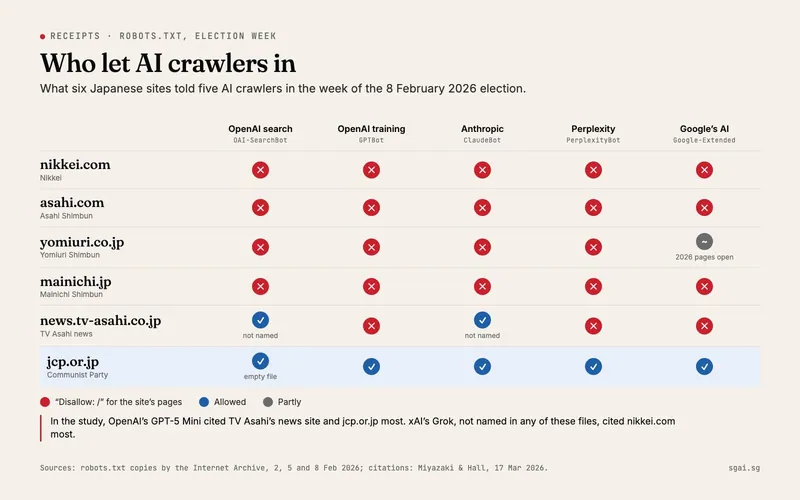
Here, “Blocked” means the file instructed the crawler to stay out—not that access was technically impossible. 2328
| Site | OpenAI search crawler | OpenAI training crawler | Anthropic (ClaudeBot) | Perplexity | Google-Extended |
|---|---|---|---|---|---|
| nikkei.com | Blocked | Blocked | Blocked | Blocked | Blocked |
| asahi.com | Blocked | Blocked | Blocked | Blocked | Blocked |
| yomiuri.co.jp | Blocked (a few sections open) | Blocked | Blocked | Blocked | Partly |
| mainichi.jp | Blocked | Blocked | Blocked | Blocked | Blocked |
| news.tv-asahi.co.jp | Allowed (not named) | Blocked | Allowed (not named) | Blocked | Blocked |
| jcp.or.jp | Open (empty file) | Open (empty file) | Open (empty file) | Open (empty file) | Open (empty file) |
The archived files were captured on 2, 5 and 8 February; settings could have differed on other days. 19 “Allowed (not named)” still leaves the site’s general restrictions on small sections in place. 33
The exceptions matter. Yomiuri allowed Google-Extended on article addresses containing 2026. 31 Mainichi’s current file now lets it into article pages, which its February copy did not. 32 Do not reduce this to “Japanese news blocks all AI”.
What this means for you: Check the specific crawler and page. A blanket description of your website’s AI policy may hide important exceptions.
What the study does not prove
The models did not read only the party’s website. OpenAI’s GPT-5 Mini cited TV Asahi’s news site most often. 35 The web-only version of xAI’s Grok cited nikkei.com most often. 36 Mainstream reporting still entered the answers.
Nikkei’s file did not name xAI or Grok, and the paper does not explain how Grok reached its material. 2937 We don’t know that route, so a citation alone cannot establish how a page was accessed.
There is a bigger uncertainty. When the researchers repeated the exercise in March with web search switched off, they report that the pattern for left-leaning profiles remained, although it weakened substantially for some models. 38
So it is unclear how much came from live searches and how much from what the models had already absorbed in training; the authors say future work should separate the two. 38 That would help establish whether changing access rules changes recommendations, rather than simply accompanying them.
A plain disclosure: Stanford Graduate School of Business describes Andy Hall as an Anthropic researcher. 18 Anthropic’s Claude Opus 4.6 showed the same broad pattern in the post-election follow-up. 16 That was a later information environment, not a direct repeat of election week. 16
Our view: agreement between assistants is not enough to settle a business question. Ask what sources support the answer, whether those sources are independent, and what relevant information might be missing.
What this means for you: Readable information matters, but this study does not prove that access settings alone caused the recommendations.
Publishers have a fair reason to close the door
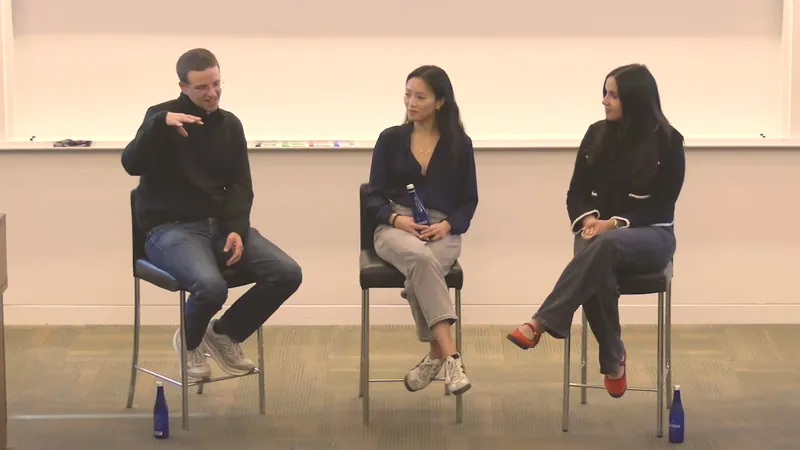
Publishers are protecting something they sell. Japan’s newspaper industry body, the Japan Newspaper Publishers & Editors Association, says AI services should obtain permission to use or train on news. It also warns about readers accepting an AI answer without visiting the original website. 1539 That is a commercial concern, not simply resistance to technology.
Hall said publishers “understandably want to come to some kind of economic agreement” over access. 40 Nikkei’s own file asks anyone who wants to use its data in machine learning (teaching AI systems from examples) to contact it, and links to its news-article data product. 41
The paper itself calls copyright-motivated restrictions “legitimate in themselves”. 42 Its argument concerns the consequences of unequal access, not whether publishers should surrender their work.
Writer Jasmine Sun described a different choice. She previously worked as a product manager at Substack, the newsletter publishing platform. 43 She said most writers wanted a blanket ban on AI scraping, the automated collection of their writing. 44 She said the product team and executives worried that a ban would mean “cutting off the future of knowledge from being influenced by Substack”. 45 So, she said, it allowed AI scraping by default, with each writer able to turn it off. 45
That is what she said; we could not independently confirm Substack’s current default. 46 Her personal position was clear: “I do allow AI scraping because I want to be in there.” 45
Who says what
| Who | What they say | How solid |
|---|---|---|
| Miyazaki–Hall paper | Blocking news sites may hand influence to open partisan sources | Working paper, not journal article |
| Andy Hall | Publishers want an economic agreement | Recorded Stanford discussion |
| Jasmine Sun | Says Substack allowed AI scraping by default, with a per-writer opt-out | Her account; current setting unconfirmed |
| Japanese newspaper association | News use and training should require consent | Official industry statement |
| Stanford’s study summary | Suggests negotiated access for news | University summary of the research |
Our distinction is simple: selling information and selling a service are different businesses. The right access policy need not be the same.
What this means for you: If content is your product, weigh exposure against licensing and lost visits. Openness is a business choice, not a duty.
Singapore’s newspapers show another way
Singapore’s biggest newspaper websites made a different choice from Japan’s.
On 21 November, The Straits Times, The Business Times and Lianhe Zaobao all told Google-Extended to stay out, except for specially marked page addresses. 474849
But The Business Times and Zaobao explicitly allowed OpenAI’s, Anthropic’s and Perplexity’s listed crawlers. The Straits Times did not name those crawlers; its general rules restricted administrative and utility pages rather than articles. 474849
Those are robots.txt instructions, not proof that every page can be retrieved through every other access control. 23 Still, they show why “this publisher blocks AI” is too crude a description.
Our view: either approach can be commercially reasonable for a publisher. A renovation firm or caterer should ask a different question: does keeping public service information out of search help the business?
Do not copy a newspaper’s settings merely because they look cautious. Decide what you want protected, and what you want prospective customers to find.
What this means for you: Choose access by purpose and company. You do not have to treat every AI system alike.
Check search access separately from AI training
Hall drew the business parallel himself at Stanford: “Anyone working in business already knows this is a thing for AI, AIO or GEO as it's sometimes called.” 50 GEO, short for generative engine optimisation, is a research term from 2023 for helping content get seen in AI-written answers. 51
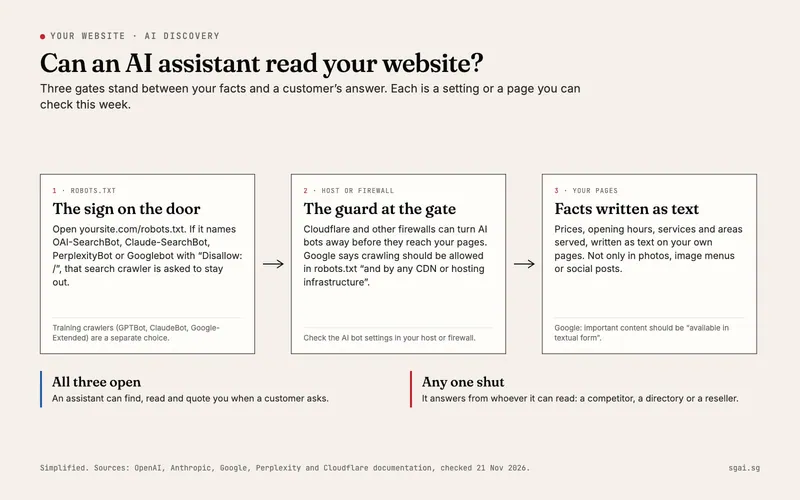
Think of access as separate checks: the permission file, the hosting system, and whether the useful facts are readable text. Google’s guidance addresses all of these. 5223 Ask your website supplier to check each, rather than simply declaring the site “AI-ready”.
Start by separating being found today from helping teach future models. OpenAI explicitly says its search and training settings are independent. You can allow its search crawler while declining its training crawler. 24
Can AI read your site? The crawler names to look for
| Crawler or control | Company | What it does | What blocking it means |
|---|---|---|---|
| OAI-SearchBot | OpenAI | Finds pages for ChatGPT search | Excludes search answers; direct website links may remain |
| GPTBot | OpenAI | Collects potential training material | Signals no use for model training |
| Claude-SearchBot | Anthropic | Collects pages for search | May reduce search visibility and accuracy |
| ClaudeBot | Anthropic | Collects training material | Signals exclusion of future material from training |
| PerplexityBot | Perplexity | Finds and links sites for its answers; not used for training | Perplexity recommends allowing it so your site can appear |
| Googlebot | Crawls for Google Search and its AI features | Restricts crawling needed for search eligibility | |
| Google-Extended | Controls Gemini training and certain live-answer uses | Does not remove Google Search eligibility |
Google-Extended needs particular care. It covers both future Gemini training and certain uses of search material when Gemini answers a question. It is not purely a training switch. 27
Blocking it does not remove your site from Google Search or Google’s AI Overviews. Those AI-written search summaries use Google Search eligibility, controlled through Googlebot and other search requirements. 2755
Permission is not a promise of placement. Google says that even when a page meets its requirements, “indexing and serving isn't guaranteed”. 55 Our guide to how assistants pick sources explains the wider decision.
What this means for you: Keep search permission separate from training permission. Ask your supplier to document both decisions by crawler name.
Check the website, not just the permission file
Your website builder may expose search settings instead of letting you edit robots.txt directly. 23 Ask whoever maintains the site to inspect those settings and any relevant plugins, rather than assuming the file tells the whole story.
A firewall—the system filtering incoming website traffic—can be another barrier. Perplexity says website owners may need to explicitly allow its bots through that protection. 54
Cloudflare, a widely used web security service, introduced a one-click block on AI crawlers in September 2024 and says more than one million customers chose it. 56 Its newer controls treat search, assistant activity and training separately. From 15 September 2026, new domains keep search allowed by default, while training and assistant bots are blocked on pages that show adverts. 57 Ask whoever set up your site which of these settings are switched on.
Then check the content. Google’s list includes making sure important content is available as text and keeping your Business Profile up to date. 52 Our advice: write services, prices, opening hours and service areas on your own pages. Do not leave the only copy inside a promotional image or social post.
Our illustration: imagine competing caterers. One publishes readable menus, delivery areas and ordering terms. The other leaves those details only in photographs. We would expect the readable site to give an assistant more useful material—not a guaranteed recommendation. Test whether the answer instead relies on a directory, reseller or competitor.
Google also says its AI search features need no special AI text file. 55 Before commissioning one, read our llms.txt guide and the more basic explanation of why ChatGPT may not know your company.
What this means for you: Check permission, hosting and readable facts together. Fix ordinary access problems before buying an AI visibility package.
What to do now
Our recommendations below depend on what your business sells, not on a blanket position for or against AI.
What to do, by situation
| Your situation | Our suggestion | What to ask your supplier |
|---|---|---|
| You sell a local service or product | Allow intended search access; publish useful text | Can assistants retrieve our main service pages? |
| You want answers, not training | Allow search crawlers; restrict training separately | Which settings control each purpose? |
| You sell content, such as publishing or courses | Consider paid or negotiated access | What should remain public, and what needs permission? |
| Your site uses a website builder | Inspect its search controls | Which setting generates our access rules? |
| You use Cloudflare or another firewall | Check its separate bot controls | Is intended search traffic actually getting through? |
| Prices and hours live in photos or social posts | Put essential facts into website text | Can someone find them without reading an image? |
If you manage the site yourself: start with your main service pages. Ask an assistant a realistic customer question, inspect its sources, and note missing or outdated facts.
If an agency manages it: request the crawler rules, hosting checks and readable-page checks in writing. Ask for evidence of access, not a guarantee that AI will recommend you.
If content is what you sell: decide which public pages should help discovery and which material needs protection. Do not let a default setting make that commercial decision for you.
We told this story in a short reel on Instagram: watch it here.
What this means for you: Make your public business facts easy to read, protect what you actually sell, and test the resulting answers.
Questions Singapore business owners are asking
Did AI chatbots make Japanese voters support the Communist Party?
The study does not establish that. It tested AI recommendations to made-up voter profiles, not real voters or changes in voting behaviour. Left-leaning test profiles produced the convergence on the Japanese Communist Party. In the actual election, the party’s seats fell from eight to four in the 465-seat chamber.
Can I appear in ChatGPT search without allowing AI training?
Yes. OpenAI says the settings are independent: allow OAI-SearchBot for search while disallowing GPTBot to signal that your content should not be used for training. Blocking OAI-SearchBot excludes your site from ChatGPT search answers, although direct website links may remain. Permission makes your content available for consideration; it is not a promise of a recommendation.
Does blocking Google-Extended remove my website from Google AI Overviews?
No. Google says Google-Extended does not affect inclusion or ranking in Google Search. It controls future Gemini training and certain uses of search content in Gemini answers. AI Overviews and AI Mode depend on ordinary Google Search eligibility, including whether Googlebot can crawl the page. Check those search settings separately.
How do I check whether AI assistants can read my business website?
Ask your website supplier to check crawler permissions, hosting or firewall restrictions, and whether essential facts appear as text. Google recommends checking all of these. Perplexity also warns that firewalls may need to explicitly allow its bots. Then test realistic customer questions and inspect the cited pages rather than judging only whether your business name appears.
Do I need an llms.txt file to get recommended by AI?
For Google’s AI Overviews and AI Mode, no. Google explicitly says you do not need new machine-readable files or special AI text files. Start with accessible pages, useful text and current business information instead. Our advice is to fix those basics before paying for extra files or accepting promises of guaranteed AI recommendations.
Sources
- [1]Why Do AI Models Tell Left-Wing Voters to Support the Communist Party? — Miyazaki & Hall working paper, 2026-03-17
- [2]Why Do AI Models Tell Left-Wing Voters to Support the Communist Party? — Miyazaki & Hall working paper, 2026-03-17
- [3]Why Do AI Models Tell Left-Wing Voters to Support the Communist Party? — Miyazaki & Hall working paper, 2026-03-17
- [4]Why Do AI Models Tell Left-Wing Voters to Support the Communist Party? — Miyazaki & Hall working paper, 2026-03-17
- [5]Why Do AI Models Tell Left-Wing Voters to Support the Communist Party? — Miyazaki & Hall working paper, 2026-03-17
- [6]A Landslide for Takaichi's LDP: House of Representatives Election Results — Nippon.com, 2026-02-09
- [7]Why Do AI Models Tell Left-Wing Voters to Support the Communist Party? — Miyazaki & Hall working paper, 2026-03-17
- [8]Voters Increasingly Use AI as Political Advisor. A New Study Shows the Risks. — Stanford FSI, 2026-03-31
- [9]Why Do AI Models Tell Left-Wing Voters to Support the Communist Party? — Miyazaki & Hall working paper, 2026-03-17
- [10]Why Do AI Models Tell Left-Wing Voters to Support the Communist Party? — Miyazaki & Hall working paper, 2026-03-17
- [11]Why Do AI Models Tell Left-Wing Voters to Support the Communist Party? — Miyazaki & Hall working paper, 2026-03-17
- [12]Why Do AI Models Tell Left-Wing Voters to Support the Communist Party? — Miyazaki & Hall working paper, 2026-03-17
- [13]Why Do AI Models Tell Left-Wing Voters to Support the Communist Party? — Miyazaki & Hall working paper, 2026-03-17
- [14]JCP issues statement on the outcome of the general election — Japanese Communist Party, 2026-02-09
- [15]Statement on Protecting News Content in Generative AI — Japan Newspaper Publishers & Editors Association, 2025-06-04
- [16]Why Do AI Models Tell Left-Wing Voters to Support the Communist Party?, Supplementary S8 — Miyazaki & Hall working paper, 2026-03-17
- [17]Voters Increasingly Use AI as Political Advisor — Stanford FSI, 2026-03-31
- [18]AI@GSB Perspectives: AI & Politics — Stanford Graduate School of Business, 2026-11-16
- [19]Internet Archive Wayback Machine — Internet Archive, 2026-02-02
- [20]AI@GSB Perspectives: AI & Politics — Stanford Graduate School of Business, 2026-11-16
- [21]Why Do AI Models Tell Left-Wing Voters to Support the Communist Party? — Miyazaki & Hall working paper, 2026-03-17
- [22]Why Do AI Models Tell Left-Wing Voters to Support the Communist Party? — Miyazaki & Hall working paper, 2026-03-17
- [23]Introduction to robots.txt — Google Search Central, 2025-12-10
- [24]Overview of OpenAI Crawlers — OpenAI, 2026-11-21
- [25]Overview of OpenAI Crawlers — OpenAI, 2026-11-21
- [26]Does Anthropic crawl data from the web, and how can site owners block the crawler? — Anthropic Help Center, 2026-11-21
- [27]Google's common crawlers — Google, 2026-10-30
- [28]RFC 9309, Robots Exclusion Protocol — IETF, 2022-09
- [29]nikkei.com robots.txt — Nikkei, 2026-11-21
- [30]asahi.com robots.txt — Asahi Shimbun, 2026-11-21
- [31]yomiuri.co.jp robots.txt — Yomiuri Shimbun, 2026-11-21
- [32]mainichi.jp robots.txt — Mainichi Shimbun, 2026-11-21
- [33]news.tv-asahi.co.jp robots.txt — TV Asahi, 2026-11-21
- [34]jcp.or.jp robots.txt — Japanese Communist Party, 2026-11-21
- [35]Why Do AI Models Tell Left-Wing Voters to Support the Communist Party? — Miyazaki & Hall working paper, 2026-03-17
- [36]Why Do AI Models Tell Left-Wing Voters to Support the Communist Party? — Miyazaki & Hall working paper, 2026-03-17
- [37]Why Do AI Models Tell Left-Wing Voters to Support the Communist Party? — Miyazaki & Hall working paper, 2026-03-17
- [38]Why Do AI Models Tell Left-Wing Voters to Support the Communist Party?, Supplementary S7 — Miyazaki & Hall working paper, 2026-03-17
- [39]Statement on Protecting News Content in Generative AI — Japan Newspaper Publishers & Editors Association, 2025-06-04
- [40]AI@GSB Perspectives: AI & Politics — Stanford Graduate School of Business, 2026-11-16
- [41]nikkei.com robots.txt — Nikkei, 2026-11-21
- [42]Why Do AI Models Tell Left-Wing Voters to Support the Communist Party? — Miyazaki & Hall working paper, 2026-03-17
- [43]AI@GSB Perspectives: AI & Politics — Stanford Graduate School of Business, 2026-11-16
- [44]AI@GSB Perspectives: AI & Politics — Stanford Graduate School of Business, 2026-11-16
- [45]AI@GSB Perspectives: AI & Politics — Stanford Graduate School of Business, 2026-11-16
- [46]AI@GSB Perspectives: AI & Politics — Stanford Graduate School of Business, 2026-11-16
- [47]straitstimes.com robots.txt — The Straits Times, 2026-11-21
- [48]businesstimes.com.sg robots.txt — The Business Times, 2026-11-21
- [49]zaobao.com.sg robots.txt — Lianhe Zaobao, 2026-11-21
- [50]AI@GSB Perspectives: AI & Politics — Stanford Graduate School of Business, 2026-11-16
- [51]GEO: Generative Engine Optimization — Aggarwal et al., arXiv, 2023-11-16
- [52]AI features and your website — Google Search Central, 2025-12-10
- [53]Overview of OpenAI Crawlers — OpenAI, 2026-11-21
- [54]Perplexity Crawlers — Perplexity, 2026-11-21
- [55]AI features and your website — Google Search Central, 2025-12-10
- [56]Cloudflare Just Changed How AI Crawlers Scrape the Internet-at-Large — Cloudflare press release, 2025-07-01
- [57]New options to manage AI traffic — Cloudflare changelog, 2026-07-01
How this was made. SGAI's desk picks the story and the Singapore angle and gathers the primary sources. An AI model drafts from those sources only. Every figure is checked against the linked source before Jay Qin reviews and publishes. Spotted an error? Email jay@sgai.sg and we will correct it here, in the open.