What is llms.txt, and does your website need one?
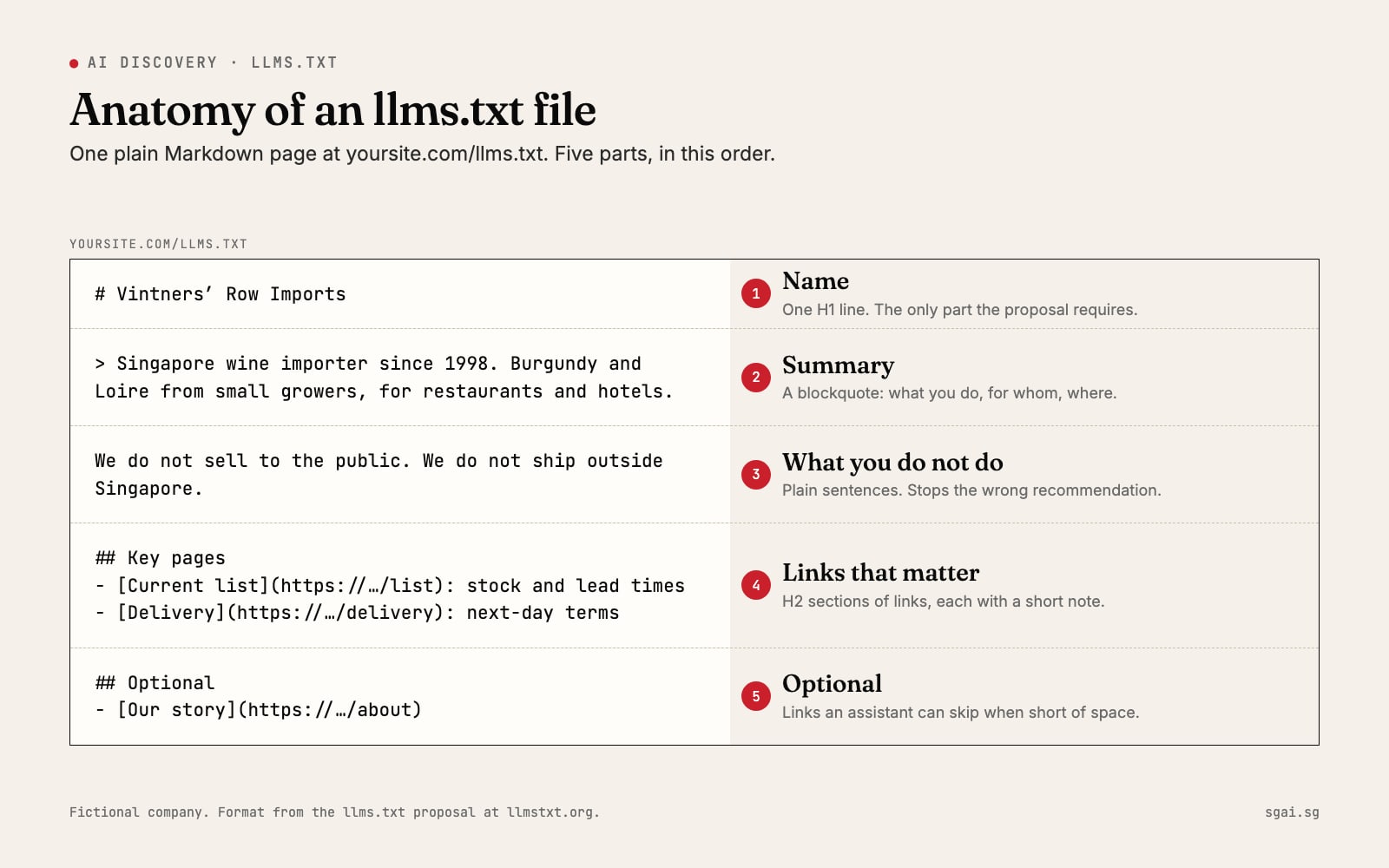
An llms.txt file is one plain page that tells AI assistants what your company does, and what it does not. It takes an afternoon to write. Whether any assistant actually reads it is still an open question, and we will be honest about that below. The surprising part is that the file is worth writing anyway, because of what it forces you to decide.

Where llms.txt comes from
The idea was proposed by the researcher Jeremy Howard on 3 September 2024. The proposal lives at llmstxt.org (checked 8 Nov 2026). His reasoning was simple. A web page is built for people: menus, banners, cookie notices, scripts. An AI model working with a limited amount of space has to dig through all of that to find the few sentences that matter. So why not put a short, clean summary at a predictable address, the way robots.txt sits at a predictable address?
The address is yoursite.com/llms.txt. The format is Markdown, the plain-text style where # marks a heading and - marks a list item. Anyone can read it in a browser, and so can a machine.
What the file is
The proposal asks for a few things, in a fixed order.
| Part | What it looks like | Required? |
|---|---|---|
| Name | One heading line starting with # | Yes, the only required part |
| Summary | A short quote block starting with > | Recommended |
| Details | Plain paragraphs or lists, no headings | Optional |
| Link sections | ## headings, each with a list of links and a short note per link | Optional |
| "Optional" section | A ## Optional list of links an assistant can skip when short of space | Optional |
That is the whole format. The proposal also suggests offering Markdown copies of your important pages, at the same address with .md added. That part is a bigger job, and you can leave it for later.
What the file is not
Three misunderstandings come up every time.
It is not robots.txt. Robots.txt tells crawlers where they may and may not go. It is a formal standard, published in 2022 as RFC 9309 (checked 8 Nov 2026), and even that standard says its rules "are not a form of access authorization". llms.txt does not block or allow anything. It only describes.
It is not a ranking trick. Google says so directly. Its page on AI features and your website (checked 8 Nov 2026) states: "You don't need to create new machine readable files, AI text files, or markup to appear in these features." So an llms.txt will not move you up in Google's AI Overviews. Anyone selling it as a shortcut is selling you something Google has publicly said it does not need.
It is not a substitute for a website. If the facts in your llms.txt are not also on your real pages, in plain text, nothing has improved. An assistant that cross-checks will find a summary that its own reading of your site does not support.
The honest part: does anyone read it?
Here is what we can say, and what we cannot.
Many companies publish one. You can open the files of documentation sites, software companies and studios, including ours. The Model Context Protocol project publishes one for its own documentation (checked 8 Nov 2026), and its introduction page opens with a note pointing AI tools to that file.
What is not publicly verified is which AI assistants fetch these files when they answer a question about a company. As of 8 November 2026, we have not found a primary statement from OpenAI, Google or Anthropic saying that ChatGPT, Gemini or Claude reads a site's llms.txt to decide what to say about that business. A developer can paste an llms.txt into a coding tool by hand. That is not the same as an assistant looking up your company on its own.
So treat llms.txt as low cost, uncertain upside. It might be read. It might not. If someone tells you it will "get you into ChatGPT", ask them for the source.
Why we still write one for every client
Because the real value is not the file. It is the afternoon you spend writing it.
To write a good llms.txt, a company has to answer questions it often has never written down:
- What do we do, in one sentence a stranger understands?
- Who is it for, and where?
- What do we not do? Which jobs should nobody send us?
- Which five pages on our site actually matter?
- Which of our facts are current, and which are from 2017?
Most established companies cannot answer these from their current website. The founding year differs between pages. The services list includes things the company stopped doing years ago. The page that matters most, the current product list, is a PDF.
Writing the file exposes all of that. And once you have one clean page of facts, you can use it everywhere: the home page, the About page, your Google Business Profile, the structured data on your site. That consistency is what helps an assistant, whether or not it ever opens llms.txt. We explain why in why ChatGPT doesn't know your company.
What to put in yours
Keep it short. One screen is enough for most businesses. Write it the way you would brief a new employee on day one.
- Your legal or trading name as the heading. Use the same name you use everywhere else.
- One summary sentence. What you do, for whom, where, since when.
- What you do not do. "We do not sell to the public." "We do not install, only supply." This is the most underrated line in the file. It stops an assistant recommending you for the wrong job, and it makes the rest of the file more believable.
- Hard facts. Address, service area, opening hours, the ways to reach you. Only facts that match your other listings.
- Key pages. The five to ten pages a buyer needs, each with a one-line note: your services, your current list or catalogue, delivery terms, contact.
- Optional. History, press, the founder's story.
Then the rule that matters most: every fact in the file must also be on your real website, in text, and must match what Google Maps and the directories say.
A template you can copy
Replace everything in square brackets. Delete any line you cannot fill truthfully. A short true file beats a long vague one.
# [Company name]

> [Company name] is a [what you are] in [city/country], founded in [year].
> We [what you do] for [who you serve].

We do not [a job people wrongly ask you for].
We do not [a second boundary, e.g. sell to the public / ship overseas].

Address: [street, postal code]
Service area: [where you deliver or work]
Contact: [email] · [phone] · [enquiry page URL]
Last updated: [date]

## Key pages

- [Services](https://[yoursite]/services): what we do, with typical project sizes
- [Current list](https://[yoursite]/list): products, stock and lead times
- [Delivery and terms](https://[yoursite]/terms): how ordering and payment work
- [Projects](https://[yoursite]/projects): past work with client type, place and year
- [Contact](https://[yoursite]/contact): how to reach us and expected reply time

## Optional

- [About us](https://[yoursite]/about): history and the people behind the company
- [News](https://[yoursite]/news): announcements and press
Save it as a plain text file named llms.txt and upload it to the root of your site, so it opens at yoursite.com/llms.txt. On most website builders and hosting panels this is a five-minute job. If you do not know who can upload files to your site, that is a more urgent problem than llms.txt. Read who actually owns your website first.
Does your website need one?
Probably yes, for one reason: it is cheap, and the process of writing it improves everything else. But keep the order right. A clear website comes first, then consistent facts across every listing, then structured data. llms.txt is the last small step on top, not the foundation.
If writing the "what we do not do" line starts an argument in your family or your management team, that is the most useful thing that will happen all month. Settle it, then publish it everywhere.