Why ChatGPT doesn't know your company, and what it takes to change that
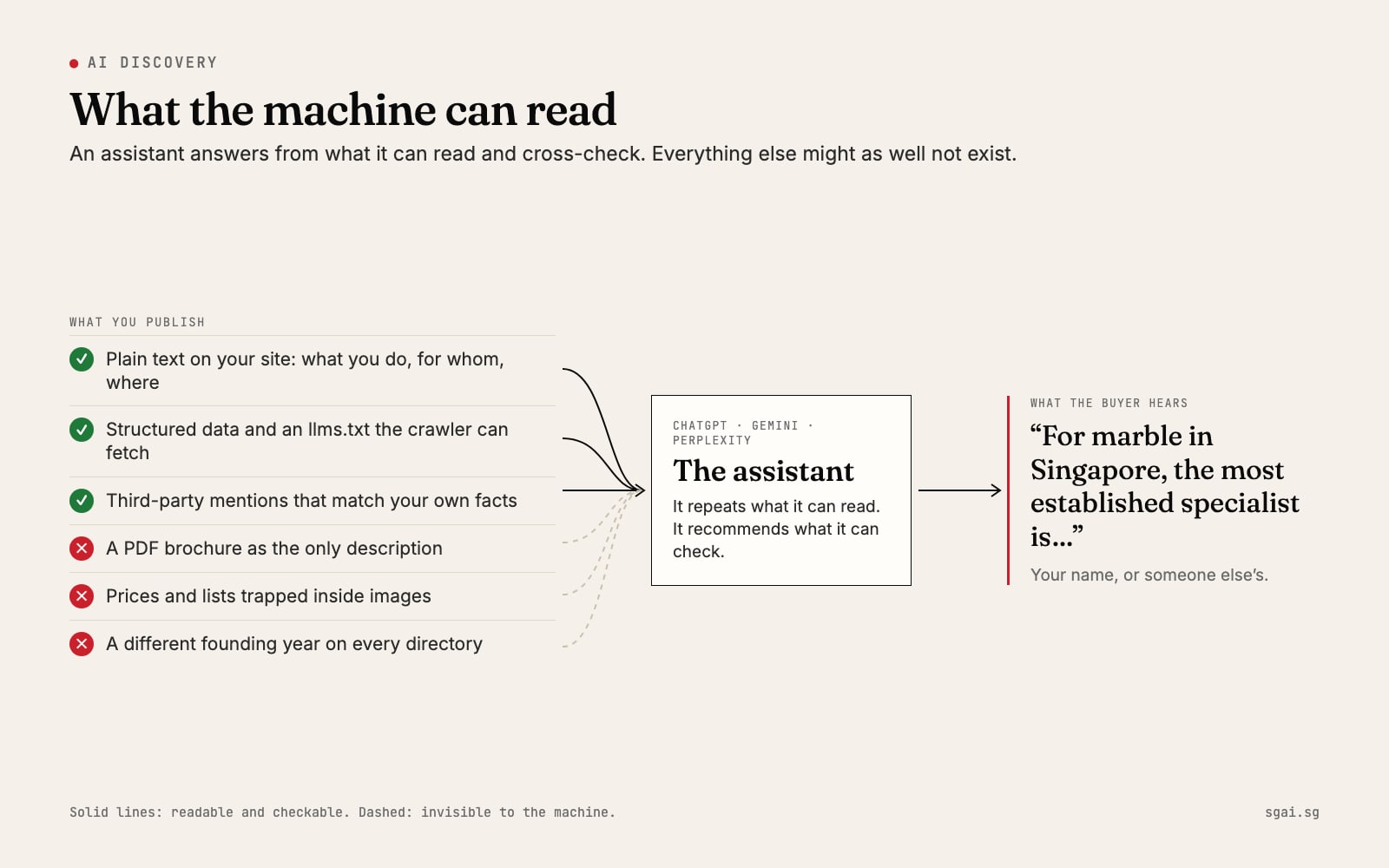
You have been in business for twenty years. Your clients know you, your suppliers know you, and half the trade knows your father by name. Then someone asks ChatGPT for a recommendation in your field, and your company is not in the answer. That is not a judgement on your work. It is a reading problem, and reading problems can be fixed.

The machine can only repeat what it can read and check
An AI assistant does not know your reputation. It has never had lunch with your clients. When it answers a question about your company, it works from text it can find: your website, directories, news articles, reviews, other people's pages that mention you.
So the question is not "is this company good?" The question the machine can actually answer is "what can I read about this company, and does it agree with itself?" If there is very little to read, or what exists is contradictory, a careful assistant will do one of two things. It will say it does not know you. Or it will recommend someone it can describe with more confidence.
That means a great business with a thin, dated website is at a real disadvantage against a weaker competitor that has simply written down who it is, clearly and consistently.
Five reasons established companies are invisible
1. Your best information is locked in images and PDFs
The company profile is a designed PDF. The certifications are photos of framed certificates. The project list is a JPEG of a slide. A person can look at these. A machine reading text often cannot, or will not trust what it extracts. Every fact that only exists as a picture is a fact the assistant may never use.
2. The site never says what you do, or for whom
"Welcome to our company. Quality service since 1998." That sentence could belong to a caterer, a law firm or a scaffolding contractor. If your home page does not say, in plain words, what you do, who it is for and where you do it, the machine has nothing to repeat. And it cannot recommend you for a job it does not know you do.
3. Your facts disagree with each other
The website says you moved to Ubi in 2019. Google Maps still shows the old Kallang address. A directory lists a phone number from 2012. One page says you were founded in 1998, another says 1999. A person shrugs at this. A machine sees two versions of the truth and lowers its confidence in both.
4. Nobody else mentions you in writing
Your reputation lives in conversations, not on pages. If no trade association, client, publication or partner has ever written about your company on the web, the assistant has nothing outside your own website to check your claims against.
5. The site only works when code runs
Many modern templates load their text with JavaScript after the page opens. Google explains how its crawler handles this in its guide to JavaScript SEO basics (checked 8 Nov 2026), and even Google needs extra steps to do it. Other crawlers may simply see an empty page. OpenAI publishes the names of its own crawlers in its overview of OpenAI crawlers (checked 8 Nov 2026), so you can check whether your site lets them in at all.
What being readable means in practice
Making a business readable to AI is not a trick. It is mostly writing things down properly. Here is what it looks like.
| Do this | Why it matters to the machine |
|---|---|
| Say what you do, for whom and where, in the first lines of the home page | It gives the assistant a sentence it can repeat |
| Say what you do not do | It stops the assistant recommending you for the wrong job, and makes the rest more believable |
| Keep one version of every fact everywhere | Name, address, phone, founding year and hours should match on your site, Google Business Profile and every directory |
| Publish proof as text | Certifications with the issuing body and date, projects with client type, place and year |
| Make every page readable without JavaScript | Any crawler can read it, not just the most patient one |
| Add structured data | A small, standard block of code that states who you are in a format machines are built to read |
On that last point, structured data is not a secret. Google documents how structured data works and has a specific guide for Organization markup (both checked 8 Nov 2026). The vocabulary itself is public at schema.org/Organization (checked 8 Nov 2026). It lets you state your legal name, address, logo, founding date and official social profiles in one place the machine can rely on.
Notice what is not on this list: tricks, keyword stuffing, fake reviews. Tricks get found out, and once a machine catches one wrong fact it has every reason to doubt the rest. The only durable approach is to be accurate and to be checkable.
A self-test you can run tonight
This takes about twenty minutes. Open ChatGPT, Gemini and Perplexity in three tabs and ask each one the same five questions. Replace the brackets with your details.
- "What does [company name] in Singapore do?"
- "Where is [company name] located, and when was it founded?"
- "Who are the leading [your trade] companies in Singapore?"
- "I need [your main service] for [a typical client job]. Who would you recommend in Singapore?"
- "Is [company name] reliable? What evidence is there?"
Then score the answers.
| Result | What it tells you |
|---|---|
| Accurate, specific, cites your website | You are readable. Keep your facts current. |
| Vague or partly wrong | The machine found you but cannot confirm much. Look for missing or conflicting facts. |
| Describes an old address, product or owner | Outdated facts are still out there. Find and correct them at the source. |
| Recommends a reseller or competitor instead | Someone else is easier to read than you are. |
| "I don't have information about this company" | You are invisible to that assistant. Start with the website. |
Save the answers with the date. Ask the same questions again in three months. That before-and-after is the clearest measure of whether anything you changed actually worked.
Why this matters more every month
Today, people ask AI before they ask people. The first question about a supplier, a clinic or a contractor is increasingly typed into an assistant. The next step is already visible: assistants shortlist vendors, and then AI agents help the human buy. A company the machine cannot verify is not on the list.
This is not a forecast. The payment networks have already started.
- Singapore, 4 March 2026. Mastercard announced its first live agentic transaction in Singapore with DBS and UOB (checked 8 Nov 2026). An AI agent booked a ride to Changi Airport, and the payment went through cards issued by DBS and UOB.
- Europe, 2 July 2026. Visa announced that 31 issuing banks across Europe had completed live agent-executed transactions (checked 8 Nov 2026), with merchants including lastminute.com and Frasers.
- 11 January 2026. Google announced the Universal Commerce Protocol (checked 8 Nov 2026), an open standard for agentic shopping co-developed with Shopify, Etsy, Wayfair, Target and Walmart.
These are consumer purchases today: a ride, a holiday, a shopping cart. But the pattern is clear. When an agent is choosing on someone's behalf, it can only choose from businesses it can read and check. For a business that sells to other businesses, the same logic will reach procurement. The companies that are legible to the machine get the order. The rest never hear about it.
Where to start
Start with the website, because every other signal points back to it. Write down what you do, for whom, and what you do not do. Put your proof in text. Make your facts match everywhere. Then build search, AI discovery and content on top, in that order.
None of this requires you to become a different company. It requires the company you already are to be written down in a way a machine can read. If your own test tonight comes back with "I don't have information about this company", we can help. We check whether AI assistants can find and verify a business, and then we fix what they cannot read. Security first, in weeks rather than months, and everything stays in your company's name.
If you have just taken over the business and are not sure where the website even lives, read taking over the family business: the first 90 days online first.