Taking over the family business? Start with the website nobody has touched since 2014
Your parents built something real. Customers have come back for twenty years, suppliers take their calls, and the name means something in the trade. Then you open the company website and find a slider from 2014, a "Latest News" post about a trade fair that ended a decade ago, and a contact form that goes to an inbox nobody checks. This is the place to start, and it is less painful than it looks.
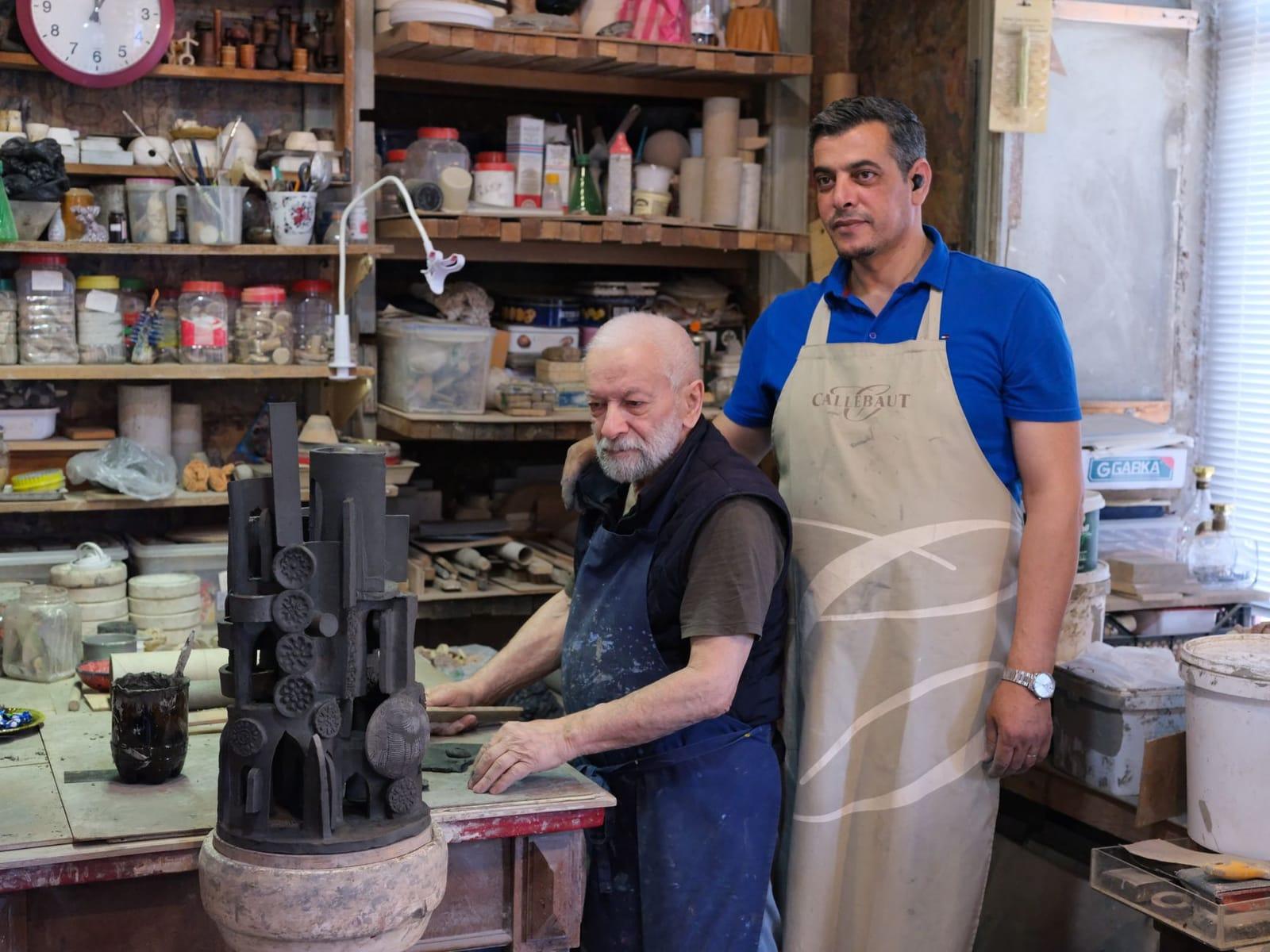
The reputation is offline. The first impression is not.
The business runs on relationships, and those relationships are the most valuable thing you have inherited. But the next buyer who has never met your father will not start with a phone call. They will search, or they will ask ChatGPT, Gemini or Perplexity. Whatever they find there is their first impression of a company your family spent decades building.
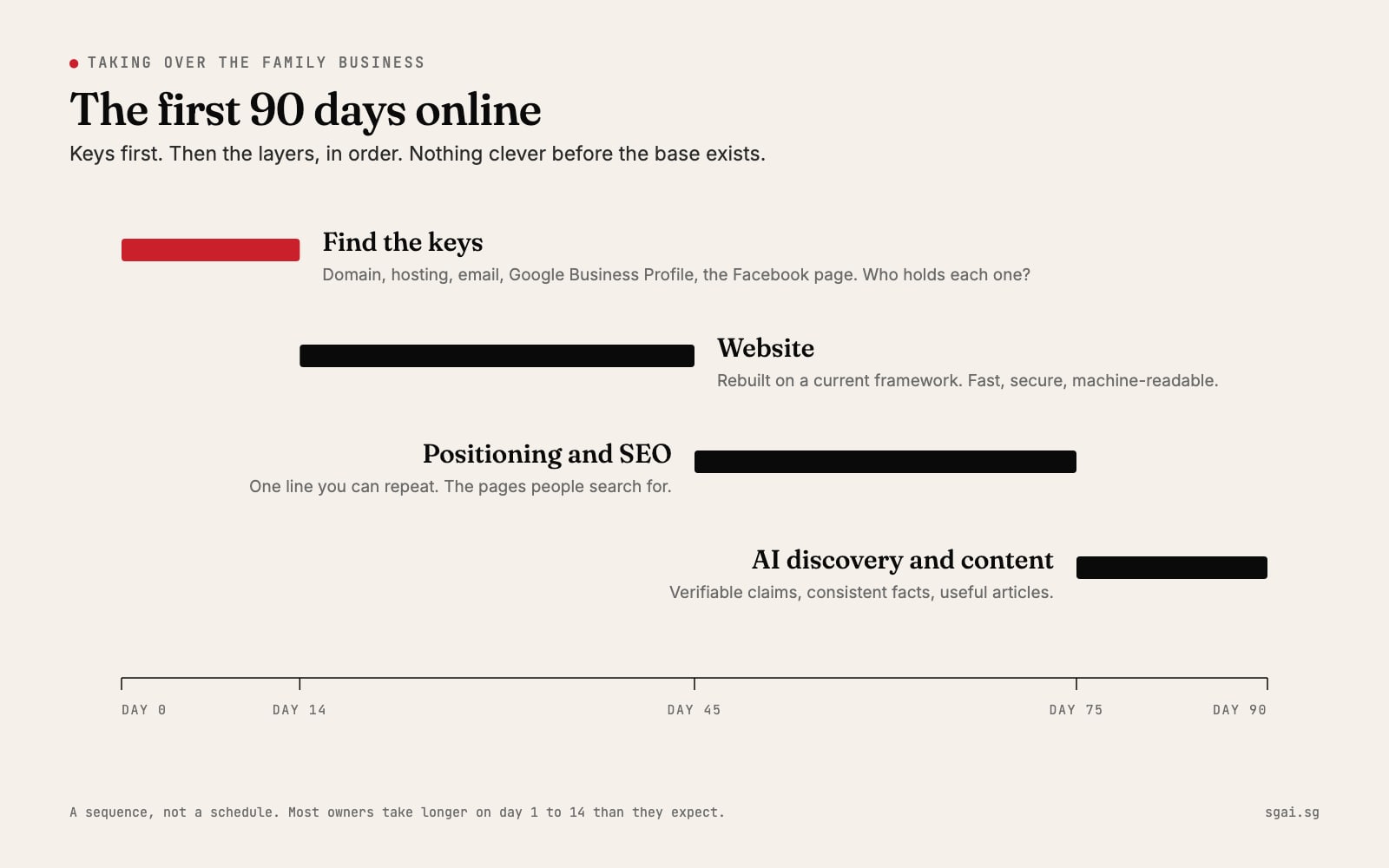
So the first 90 days are not about a redesign. They are about finding out what you actually own, what strangers and machines see, and what to fix first. Here is the order we would follow.
Days 1 to 30: find out who holds the keys
Before you change a single word, find out who controls each piece of your digital presence. In family businesses the answer is often surprising: a cousin who set up the domain as a favour, a vendor who closed in 2017, a former manager whose personal Gmail is the recovery address for everything.
Make a list of six things and, for each one, write down whose name it is in and who can log in.
- The domain. For a .sg domain, look up the registrant through SGNIC's domain search (checked 8 Nov 2026). For other endings, ICANN Lookup (checked 8 Nov 2026) shows the registrar. If the domain expires and nobody gets the renewal email, your website and your email stop together.
- The hosting. Who pays the bill, and to whom? An old shared-hosting plan on someone's personal card is common.
- The company email. Who is the administrator? If a former staff member is, they can still read or reset everything.
- The Google Business Profile. This is the listing with your address, hours and reviews on Google Maps. If someone else owns it, Google has a process to request ownership of a Business Profile (checked 8 Nov 2026).
- The Facebook page and other social accounts. Check who is an admin, not just who posts.
- The website itself. Is there a log-in page? Who has the password? When was the software last updated?
The goal for month one is simple. Every one of these should be in the company's name, with at least two people inside the company able to get in. That means if someone leaves, falls out with the family or simply forgets, the business does not lose its front door.
This is also the most important security step you will take. An old website with a public log-in page, plugins nobody has updated and a password shared by four people is not just dated. It is a liability.
Days 15 to 45: read your site as a stranger, then as a machine
Once you know what you own, look at it with fresh eyes. Do it twice.
As a stranger
Open the site on your phone. Pretend you have never heard of the company. Then answer three questions within ten seconds of landing:
- What does this company do?
- Who is it for?
- Why should I believe it is good at it?
Most sites built a decade ago fail all three. The home page says "Welcome to our company" and "Quality service since 1998", which tells a stranger nothing. The proof that matters, the big projects, the long client relationships, the certifications on the office wall, is not there at all, or sits inside a PDF brochure or a photo of a certificate.
As a machine
AI assistants and search engines read text. They do not look at your brochure the way a person would. So ask the same three questions of the raw words on the page. If the answer to "what do you do" is in an image, a scanned PDF or a slider that only appears after the page runs code, the machine may never see it. Google explains how its own crawler handles this in its guide to JavaScript SEO basics (checked 8 Nov 2026). Other crawlers are often less patient.
Days 15 to 45: ask ChatGPT about your company
This takes ten minutes and is often the most useful thing you will do all month. Open ChatGPT, Gemini and Perplexity and ask each of them:
- "What does [company name] in Singapore do?"
- "Who are the best [your trade] companies in Singapore?"
- "Would you recommend [company name] for [your main service]?"
Write down what each one says. You will usually see one of three results. The assistant has never heard of you. It describes an old product line or an address you left years ago. Or it sends the buyer to a reseller or a competitor.
None of this is about the quality of your work. It is about what the machine can read and check. We explain why in more detail in why ChatGPT doesn't know your company.
Days 30 to 90: fix things in the right order
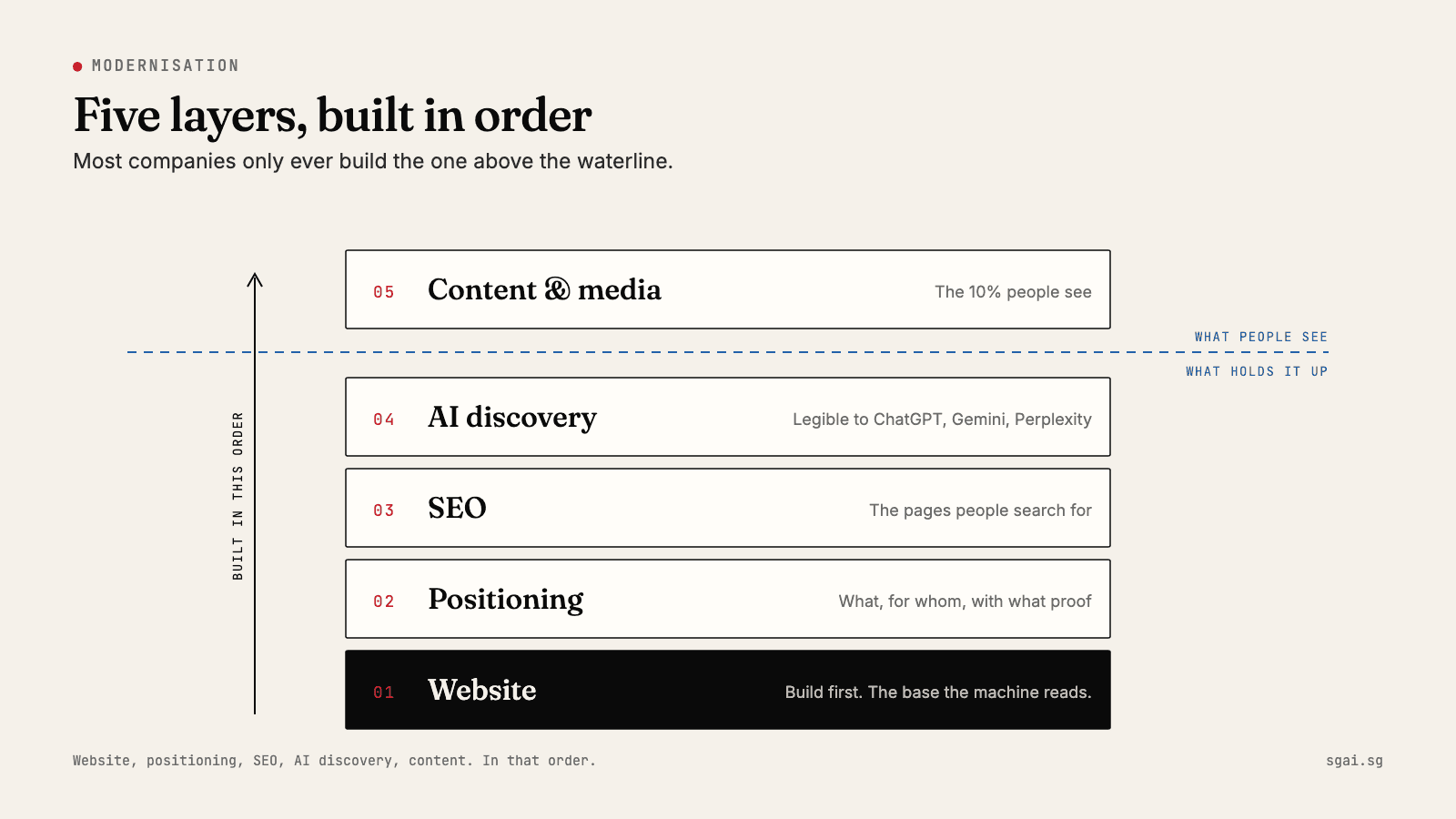
Now you know what you own and what people and machines see. It is tempting to jump straight to the visible part, a new logo, an Instagram account, a video. Resist that. Being found and recommended is built in five layers, and they only work in order.
| Layer | What it means | Why it comes here |
|---|---|---|
| 1. Website | Secure, fast, on current technology, in the company's name | Everything else points to it. If it is a liability, nothing built on it lasts. |
| 2. Positioning | What you are known for, for whom, and what you do not do | The website is where you work this out and write it down. |
| 3. SEO | Pages written in the words buyers actually search | SEO is positioning in the buyer's words. You cannot do it before you know your positioning. |
| 4. AI discovery | Facts and proof that AI assistants can read and check | Assistants recommend what they can verify. |
| 5. Content and media | Articles, photos, video | The part people see. It only compounds once the base exists. |
Most companies only ever build the last layer, the part people see. That is why a video can get a thousand views and change nothing.
For a second-generation owner, layer two is where your perspective matters most. You can see the business from inside, through years of dinner-table conversations, and from outside, through school or work overseas. That is exactly the view you need to write down what the company is really known for, in words a stranger understands.
What to keep and what to retire
Modernising is not erasing. Some things your parents built are your strongest assets online, and they are usually missing from the old website.
Keep, and put in writing:
- The year the company started and the people who started it.
- The long client relationships, described honestly and with permission.
- Real projects with real dates, places and photos.
- Certifications, licences and memberships, written as text with the issuing body and the date, not only as a photo of the certificate.
- The way your company does things that competitors do not.
Retire:
- The "Latest News" section that stopped in 2014. An abandoned news page tells every visitor the company has stopped paying attention.
- Stock photos of handshakes and people in headsets who have never worked for you.
- Phrases like "quality service" and "customer satisfaction" that every competitor also uses.
- Old phone numbers, addresses and product lines that still appear anywhere online. Every outdated fact is something an AI assistant might repeat.
- Any log-in page, plugin or account that nobody in the company controls.
Your 90-day checklist
- List the domain, hosting, email, Google Business Profile, social pages and website, and who controls each
- Move every one of them into the company's name, with two people inside the company able to log in
- Remove former staff and vendors from admin access
- Read the home page on your phone as a stranger: what, for whom, why believe it
- Check whether your key facts are in text, not only in images and PDFs
- Ask ChatGPT, Gemini and Perplexity about your company and save the answers
- Write one paragraph on what the company is known for, and what it does not do
- Collect the proof: founding year, projects, certifications, long relationships
- Fix the website first, then positioning, SEO, AI discovery, and content last
- Ask the assistants the same questions again at day 90 and compare
You do not have to do this alone
Taking over a family business is already a full-time job. Most owners we meet do not want another system to learn. They want someone who understands both the old way the business runs and the new way buyers find it, and who will do the work properly.
That is how we work. Security comes first. The first version takes weeks, not months. And you own everything: the code, the accounts and the domain stay in your company's name, so you are never handed back to a vendor you cannot reach. If you would like a second pair of eyes on what you found in your first 30 days, start a conversation with us.