What is MCP? A plain guide for business owners
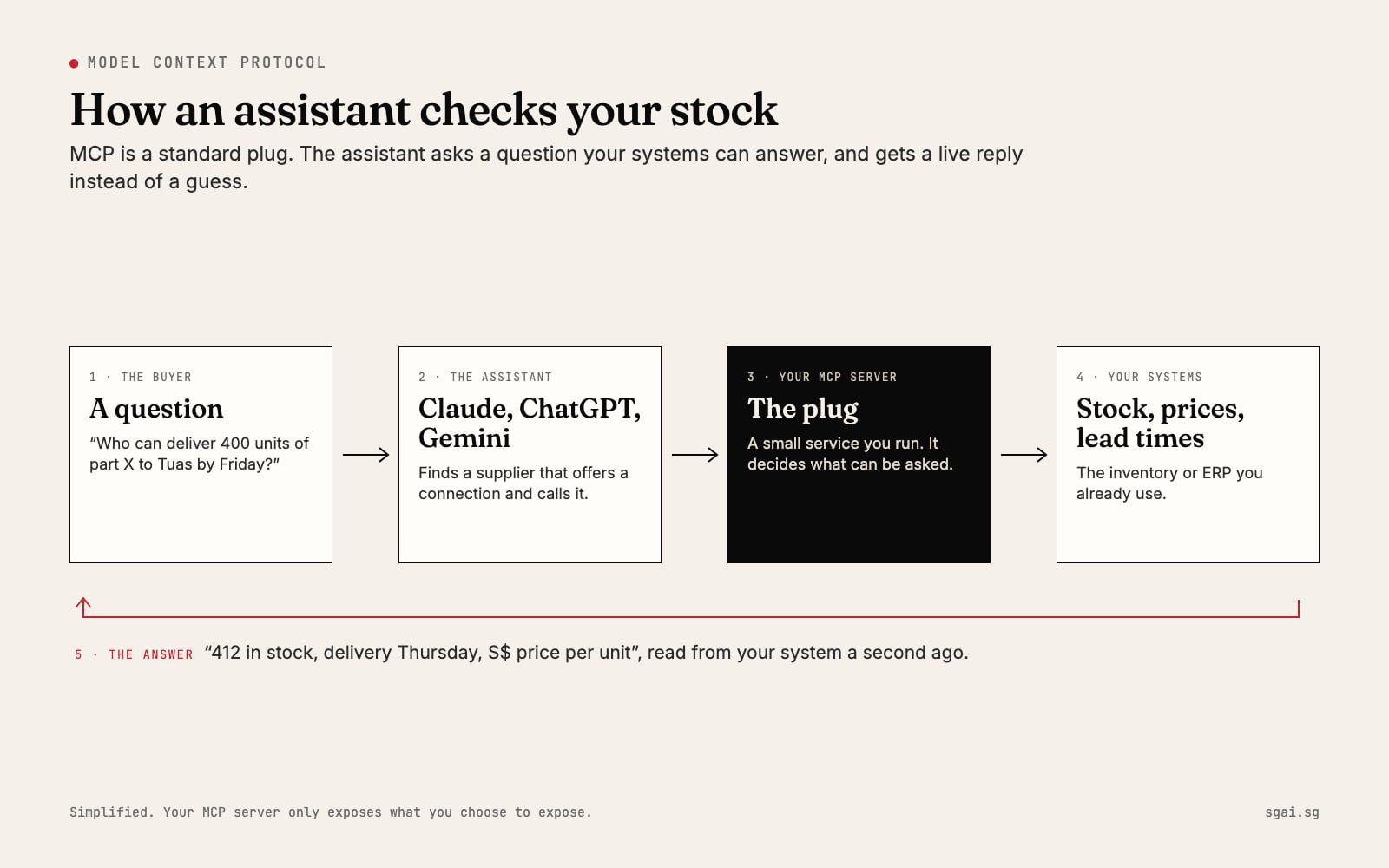
Today, when a buyer asks an AI assistant "who has this part in stock?", the assistant reads web pages and guesses. MCP is the standard that lets it ask your systems instead, and get a live answer: this many units, this price, delivery on this day. It is new, it is real, and most suppliers do not need to build anything yet. Here is what it is, who is behind it, and what to do first.
MCP in one paragraph
MCP stands for Model Context Protocol. The official site describes it as "an open-source standard for connecting AI applications to external systems", and compares it to a USB-C port: one standard plug instead of a different cable for every device (modelcontextprotocol.io, checked 8 Nov 2026).
In business terms: your company runs a small service, called an MCP server, that sits in front of a system you already have. Your stock list, your price book, your booking calendar. An AI assistant that supports MCP can connect to that server and ask it questions in a fixed, predictable way. Your server decides what may be asked and what is answered. Nothing else in your systems is exposed.
Who created it, and who runs it now
Anthropic, the company behind Claude, introduced MCP on 25 November 2024 (checked 8 Nov 2026) as an open standard. It was open from day one, which matters: any company can build on it without permission or fees.
A year later, ownership moved. On 9 December 2025, Anthropic donated MCP to the Agentic AI Foundation (checked 8 Nov 2026), a fund under the Linux Foundation, the non-profit that also hosts Linux itself. Anthropic, Block and OpenAI co-founded the foundation, with support from Google, Microsoft, Amazon Web Services, Cloudflare and Bloomberg. The MCP project's own announcement (checked 8 Nov 2026) says the day-to-day technical decisions stay with the protocol's maintainers, and that the Linux Foundation "will not dictate the technical direction of MCP."
Why should a supplier care who owns a protocol? Because standards owned by one company can be changed or abandoned by that company. A standard held by a neutral foundation, backed by competing AI companies at once, is a safer thing to build on.
Who uses it
Only what the primary sources say, with dates:
| Source | What it states | Checked |
|---|---|---|
| Anthropic, 9 Dec 2025 | MCP has been adopted by ChatGPT, Cursor, Gemini, Microsoft Copilot and Visual Studio Code; more than 10,000 active public MCP servers | 8 Nov 2026 |
| OpenAI developer docs | OpenAI's Responses API can connect to remote MCP servers on the public internet | 8 Nov 2026 |
| modelcontextprotocol.io | Claude, ChatGPT, Visual Studio Code and Cursor are listed among supporting clients | 8 Nov 2026 |
Note what the first row is: Anthropic's own count, published in its own announcement. It is a claim by an interested party, not an independent audit. It is still the best primary figure available.
The short version: the three biggest assistant makers have all lined up behind the same plug. That has not happened often in this industry.
What it looks like for a supplier
Take a fictional example. A distributor of industrial fasteners in Singapore holds about 6,000 product lines. A procurement manager at a shipyard asks her company's assistant: "Find 400 M12 stainless hex bolts, grade A4-80, delivered to Tuas by Friday."
Without MCP, the assistant searches the web. It finds the distributor's site, maybe a PDF catalogue from 2022, and a page saying "please call for stock". It cannot confirm anything. At best it lists the company with a note: "availability unknown, contact supplier." At worst it picks a competitor whose website shows stock in plain text.
With MCP, the distributor runs a small server connected to its inventory system. It offers three questions: look up a product by specification, check stock, and quote a delivery date to a postal code. The assistant asks all three and reports back: "412 in stock, delivery Thursday, price per unit as listed." The procurement manager sees a confirmed answer, from the source, a second old.
That is the difference: a guess from a stale page versus a fact from the system of record.
What it does not do
It is worth being plain about the limits.
- It does not make you visible. An assistant has to know your company exists, and trust it, before it will call your server. That still comes from your website, your listings and what others write about you.
- It does not replace your sales process. You decide what the server answers. Many B2B suppliers will expose stock and lead times but keep contract prices behind a login.
- It is not free of risk. Any system an outsider can query needs proper security. The MCP project publishes its own security best practices (checked 8 Nov 2026). Read-only access to a small, chosen set of data is the safe place to start.
- Not every assistant will connect to every server. How assistants discover and choose which business servers to call is still settling. Today, many connections are set up by the user or their company, not found automatically.
What it means for a Singapore supplier in the next two years
We will not make a forecast we cannot source. Here is what the public record already shows. The payment networks are running live transactions made by AI agents, including Mastercard's first in Singapore with DBS and UOB (4 March 2026, checked 8 Nov 2026). The large assistants support MCP. The protocol has moved to a neutral foundation.
Put those together and the direction is clear, even if the speed is not. Buyers will increasingly ask assistants to find and compare suppliers. Assistants will prefer answers they can confirm. A supplier whose stock, prices and lead times can be read directly will be easier to choose than one that says "call us".
This will reach businesses with many products and fast-moving stock first: distributors, wholesalers, importers, parts suppliers. A business that sells bespoke projects, like an architect or an events company, will feel it later, and mostly through bookings and availability.
What to do now
In order. Do not skip ahead.
- Make the website readable. Every product, service and fact in plain text, not in PDFs or images. This is what gets you on the assistant's list at all. If that is not true today, MCP is not your problem yet. Start with why ChatGPT doesn't know your company.
- Get your data into one clean place. MCP needs a system to read from. If your stock lives in three spreadsheets and one person's head, an MCP server has nothing reliable to answer with. We cover this in from spreadsheet to a catalogue your team edits.
- Publish a product or list page with dates. A page that shows stock status and a "last updated" date is the human-readable version of what MCP will later serve live. It helps people and assistants today.
- Check what your current systems already offer. Some platforms already provide this layer for you. Shopify, for example, documents how AI agents can search a store's catalogue over MCP, and how that has since moved into the Universal Commerce Protocol, an open standard Shopify co-developed with Google (Shopify developer docs, checked 8 Nov 2026). Ask your vendor before you build anything. Our guide on connecting the systems you already have shows how to ask the question.
- Then, and only then, run a small MCP server. Read-only. Two or three questions. Stock, lead time, specification lookup. Watch who calls it and what they ask.
MCP is the last step of a modern supplier's setup, not the first. The suppliers who will benefit most are the ones who did the boring work earlier: clean data, a readable website, facts that match everywhere. When the assistants come asking, those suppliers will have something true to say.