What an event agency's AI sees when it looks for staging in Singapore
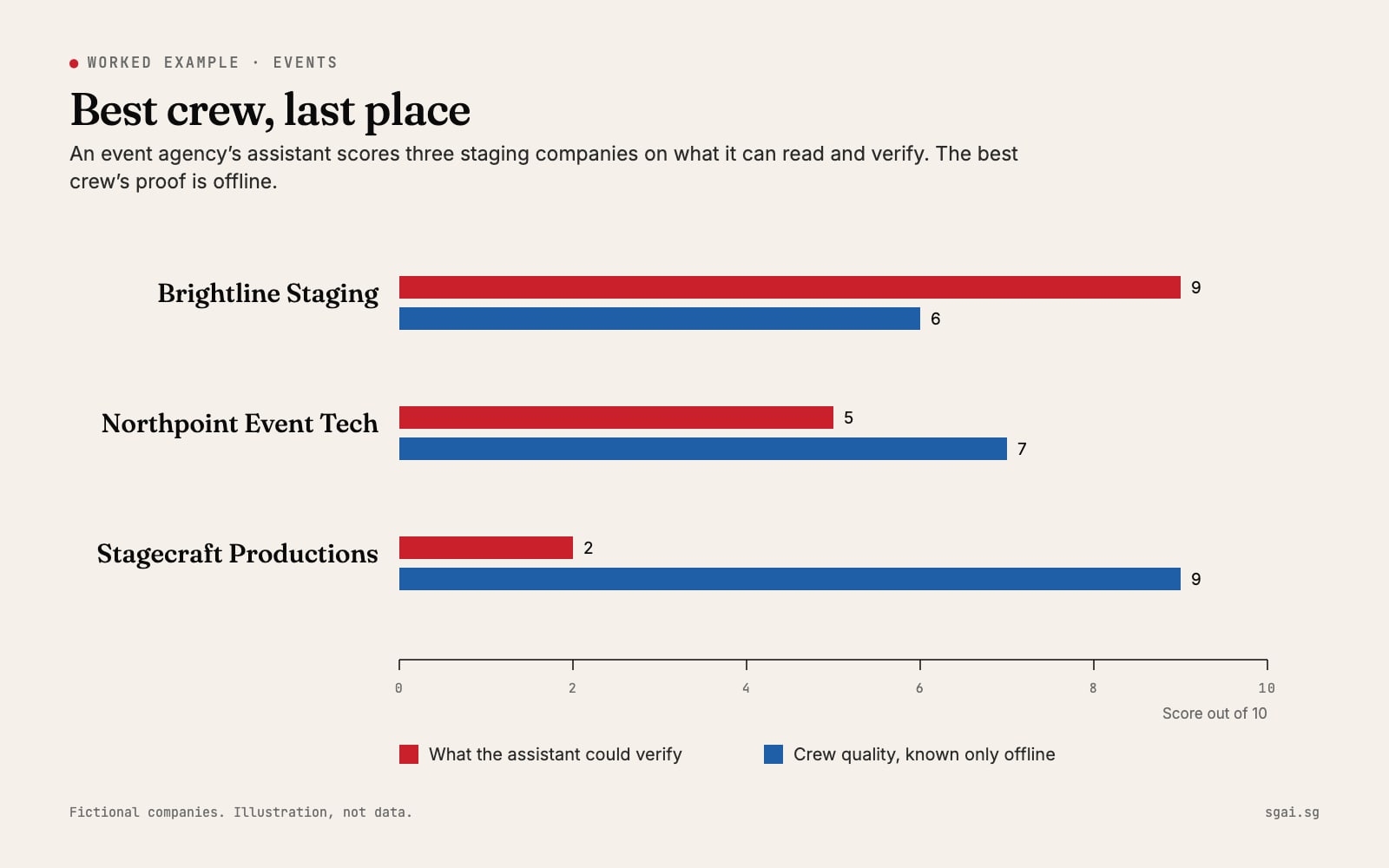
Three production companies. One brief. The company with the best crew in the room comes last, and nobody tells it why. This is a worked example with fictional companies and every assumption written down, so you can check our reasoning and run the same test on your own website.

The brief
An account manager at an event agency in Singapore has a client conference in March: 2,000 seats in a hotel ballroom, a main stage with an LED wall behind the speakers, two side screens, and three days of rehearsal and show. She is busy. She asks the agency's AI assistant to do the first pass:
"Find three Singapore production companies that can build a stage and LED wall for a 2,000-seat conference. Shortlist them, with evidence they have done this size before, and flag any risks."
This is now an ordinary request. The assistant will search the web, open each company's site, try to read what is there, and check it against other sources. Then it writes a shortlist with reasons.
The three companies
All three are fictional.
Stagecraft Productions, established 2004. The best crew of the three. Its riggers and LED technicians have built shows for audiences far larger than 2,000, and agencies that have worked with them say so, privately. Its website was built in 2015. The home page is a full-screen photo slideshow with the words "Passion. Precision. Production." The company profile is a 14-page PDF. Past projects appear as a gallery of uncaptioned photos. Its safety certificates are photographed and posted as images. The phone number on the site differs from the one on its Google Business Profile.
Northpoint Event Tech, established 2016. A good crew, a modern template website. The copy is confident but general: "end-to-end event solutions for every scale". It lists its equipment by category, without models or quantities. It shows six case studies, four of them without a date or audience size.
Brightline Staging, established 2019. The least experienced crew of the three. But its website is written as text. Each service has its own page. The equipment page lists LED panel models, total square metres of LED wall it owns and stage deck sizes. Each case study states the venue type, the audience size, the month and year, and what was built. Its safety certification is written out with the issuing body, certificate number and expiry date. Its address and phone number match everywhere.
What the assistant can read and check
The assistant cannot see the crew. It can only see what each company has written down. So we score each on five things it needs to answer the brief, at 0 to 2 points each.
| What the assistant needs | Stagecraft | Northpoint | Brightline |
|---|---|---|---|
| Says in text that it builds conference stages with LED walls | 1 | 2 | 2 |
| States equipment and capacity it can check | 0 | 1 | 2 |
| Dated past projects of 2,000 seats or more | 0 | 1 | 2 |
| Safety credentials in text, with issuer and date | 0 | 0 | 2 |
| Name, address and phone consistent across sources | 1 | 1 | 1 |
| Total out of 10 | 2 | 5 | 9 |
Brightline loses a point on consistency only because one old directory still lists its first address. Nobody scores perfect.
Why Stagecraft scores 2
Go line by line.
- Capability. The slideshow has no text the assistant can use. The word "Production" alone does not say "conference stage with LED wall". The PDF profile might, but text inside a designed PDF is often extracted out of order, or not at all if the pages were exported as images. The assistant gets one point because a page title mentions "staging".
- Equipment. Not on the site. Maybe in the PDF. The assistant cannot be sure, so it does not count it.
- Past projects. Twenty beautiful photos, no captions. A person sees a huge arena show. The machine sees
IMG_4471.jpg. It cannot tell the date, venue or audience size. - Safety. A photo of a framed certificate is a picture. The assistant cannot reliably read the issuer, number or expiry, and it cannot check it.
- Consistency. Two different phone numbers. One point, because the name and address match.
None of this is about quality. Every gap is a fact that exists in the company's office and not on its website.
What the shortlist says
Here is the kind of shortlist the account manager receives (an illustration, written by us):
- Brightline Staging. Builds conference stages with LED walls. Lists 120 m² of owned LED panels. Three documented conferences of 1,800 to 2,500 seats in 2025 and 2026. Safety certificate valid to 2027.
- Northpoint Event Tech. Offers full event production. Two dated case studies of large conferences. Equipment listed by category only. Recommend asking for an inventory.
- Stagecraft Productions. Long-established. Website gives little detail on equipment or comparable projects, and contact details differ between sources. Could not verify capacity for this brief.
Stagecraft is on the list only because the brief asked for three. With a brief that asked for two, it would not appear at all. And notice the tone of the third line. "Could not verify" reads like a warning, even though it is only a gap in the website.
The account manager is busy. She calls the first two.
Why the best crew came last
Because the machine ranks proof, not quality. It cannot ask around the industry. It cannot sense twenty years of reputation. It reads what is published and gives more weight to what it can check.
Stagecraft's real advantages, its people, its record, its safety culture, are all true. They are all offline. In a phone call with someone who knows the trade, Stagecraft wins. In a written shortlist assembled by a machine, it never gets the phone call.
This is the pattern we see in established companies across many trades. The older and more trusted the business, the more its proof lives in relationships, and the less of it is written down where a machine can read it. We explain the general mechanism in why ChatGPT doesn't know your company and how AI assistants decide who to recommend.
What Stagecraft would change
None of these require a new crew, a new logo or an advertising budget. They require writing down what is already true.
- A plain home page sentence. "Stagecraft Productions builds stages, LED walls and show systems for conferences and live events in Singapore, from 200 to 10,000 seats. Established 2004." That one line fixes the capability score.
- An equipment page in text. Models, quantities, square metres of LED, maximum stage size, power and rigging capacity. The same list the crew chief already keeps.
- Captioned projects. For every past project: venue type, audience size, month and year, what was built. Twelve good entries beat two hundred photos.
- Credentials as text. Each certificate written out: name, issuing body, number, expiry date. Keep the photo too, but put the facts beside it.
- One phone number everywhere. Fix the Google Business Profile and every directory listing to match the website.
Under the same scoring, those five changes move Stagecraft from 2 to 9 or 10. Its crew then does the rest, as it always has.
Assumptions in this worked example
- All three companies, their histories and all their details are fictional.
- The assistant is a general-purpose AI assistant with web search, used by the agency without special tools or paid databases.
- The assistant reads websites, PDFs where it can extract text, Google Business Profiles and public directories. It does not phone anyone or read private reviews.
- Text in PDFs and images is treated as uncertain. Some assistants can read some images; we assume it does not trust what it reads from them.
- The five scoring criteria and the 0 to 2 scale are ours, chosen to match the brief. Real assistants do not publish their scoring.
- The crew quality scores in the cover chart are invented, to make the point that verified evidence and real quality can point in opposite directions.
- The shortlist text is our illustration of a typical output, not a recorded response from any specific product.
Run the test on your own company
Ask an AI assistant the question your best client would ask, in their words. Then ask it what evidence it found. If its answer for your company says "could not verify", look at the list above. The fix is almost always something you already know and have never written down. If you are the second generation in the business, taking over the family business: the first 90 days online shows where to start.