Writing down know-how before it retires
Only three people really know how this works. They know which supplier to call when the usual one is short, why one customer gets a different finish, what the machine sounds like just before it jams. None of it is written down. When they retire, the know-how that made the company good leaves with them. You can catch most of it in a month, in their own words, without turning anyone into a writer.

Why this is urgent, and why it gets put off
The people who know the most are usually the busiest, and they rarely think of what they know as special. "It's just how we do it." So the job gets put off until someone hands in a retirement date.
In Singapore, the timing is now written into law. The Ministry of Manpower's page on retirement and re-employment (checked 8 Nov 2026) says the minimum retirement age is 64 from 1 July 2026 (lower for some older age groups), and the re-employment age is 69. So some of your most experienced people may stay on past retirement age, and some may not. Either way, there is a date, and the time before it is when the know-how can still be written down.
What tacit knowledge looks like
Tacit knowledge is what people know but have never had to explain. It usually comes in four shapes:
| Shape | Example | How to catch it |
|---|---|---|
| Steps | How to set up the line for a short run | Record a walkthrough, then write a checklist |
| Judgement | When a job is worth taking, and when it is not | Interview for decision rules |
| Signals | The sound, smell or reading that means trouble | Ask for stories of past problems |
| Relationships | Who to call, and what they care about | A contact list with a note on each |
Steps are the easiest to capture. Judgement is the most valuable, and the one most often lost, because the person rarely notices they are using it. That is why the methods below lean on stories and real examples rather than asking anyone to "write down what you know".
Four ways to capture it
Interviews
Sit down for an hour with one person and one topic. Ask for stories, not rules: "Tell me about the last time this went wrong." "What would a new person get wrong in their first month?" "What do you check that nobody asked you to?" Record the audio with permission. A phone is enough.
Recorded walkthroughs
For hands-on work, film over the person's shoulder while they do the job and talk through it. Ask them to say why, not just what: "I'm tightening this one last because…". Keep each video short and about one task, so a new person can find the one they need in a minute.
Decision rules
Turn judgement into plain sentences: "If the order is under X units and the finish is custom, quote a longer lead time, because the setup takes a full day." Write them in the person's own words, then ask them to check. A short list of real rules is worth more than a long manual nobody reads.
Checklists
For anything with steps, write a checklist that fits on one page. Test it by asking someone less experienced to follow it while the expert watches. Every place they hesitate is a missing line.
Where it goes: inside and outside
Most of what you capture belongs in internal documentation: a shared folder or a simple internal wiki, organised by task, with the videos and checklists side by side. Keep it where people already work, or nobody will open it.
Some of it can become public explainers on your website. "How we choose timber for outdoor doors." "Why we recommend a longer curing time." These are some of the most useful pages a company can publish. They show real expertise, and they answer the questions buyers actually ask. Google's guidance on helpful, reliable, people-first content (checked 8 Nov 2026) asks whether content shows "first-hand expertise and a depth of knowledge" and provides "original information". Know-how written down from your own floor is exactly that.
The same pages also help with AI assistants, which answer from pages they can read. A clear explainer in your words gives them something accurate to quote. We cover that in how AI assistants decide who to recommend.
What to keep private
Not everything should be published. Keep inside:
- Pricing logic, margins and supplier terms.
- Customer names and details, unless they have agreed in writing.
- Anything that is a genuine trade secret: a recipe, a formula, a process step competitors would copy.
- Safety-critical procedures, which belong in controlled internal documents.
A useful rule: publish the why and the what to look for. Keep the exact how inside.
A 30-day plan
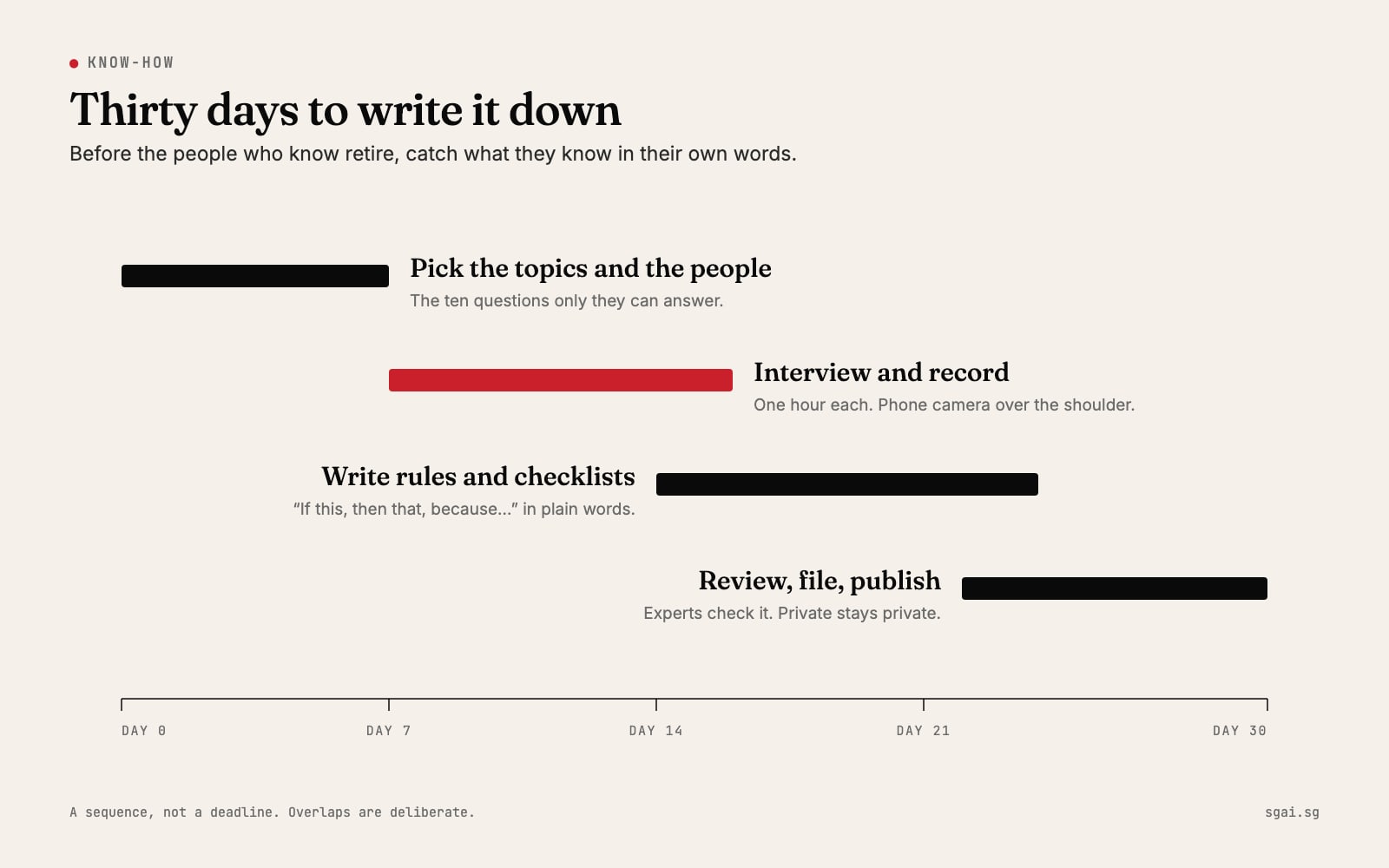
Days 1 to 7: pick the topics and the people. List the people whose departure would hurt most. For each, write the ten questions only they can answer. Agree times with them, and explain why: you are protecting their work, not replacing them.
Days 7 to 16: interview and record. One hour per topic. Record audio for interviews and video for hands-on tasks. Do not edit yet. Just collect.
Days 14 to 24: write rules and checklists. Turn recordings into decision rules and one-page checklists. Have the recordings transcribed so you are editing text, not typing from scratch. Keep the expert's own phrases.
Days 22 to 30: review, file, publish. The expert checks every page. File everything in one shared place, organised by task. Pick two or three topics that are safe to share and turn them into public explainers on your website.
At day 30 you will not have everything. You will have the most important things, a habit, and a place to put the rest.
Where we come in
You can run this plan with your own team, and you should start before anyone else gets involved. Owners usually ask us for help with the second half: turning recordings into clear explainers that work on the website, and building the internal library so it stays organised. If you are also taking over the business, our guide to the first 90 days online shows where this fits.