Deepfake scams in Singapore: what the S$4.9 million fake Zoom call teaches businesses
The fake leaders were mostly old videos with new voices. The business lesson is not to become a deepfake detective. It is to make every unusual payment survive an independent check.
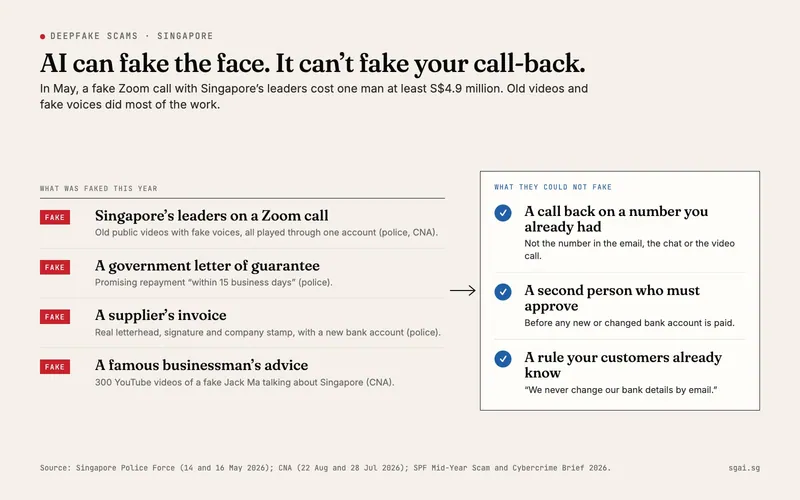
In May 2026, Singapore police said a man transferred at least S$4.9 million after a Zoom call with fake versions of the Prime Minister, the President and a minister. 12 None of them was really on the call. 3
CNA, which examined the full recording, later found the faces were mostly old public videos with fake voices added. 45 That is a deepfake: video or audio altered with artificial intelligence (AI) so that real people appear to say things they never said. 24
Our view: you will not reliably spot every fake. Build a payment habit that does not depend on spotting one.
What happened in the S$4.9 million deepfake Zoom scam?
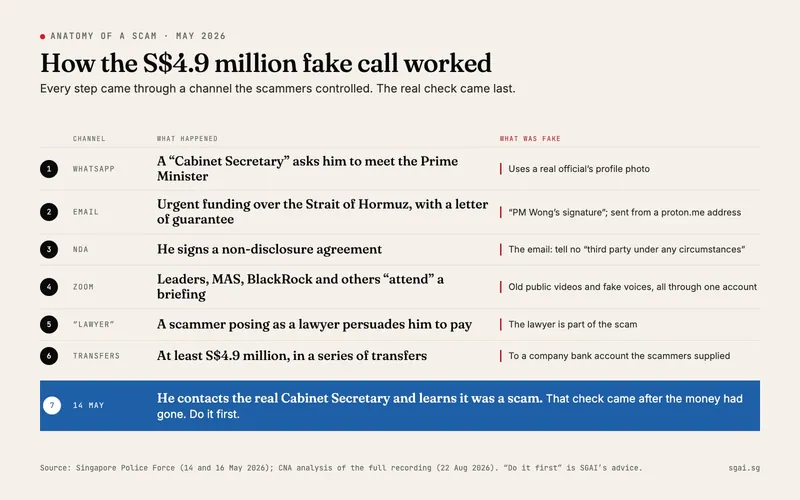
The Singapore Police Force (SPF) described a carefully staged approach. Police said the scammers appear to target “business professionals who have had prior interactions with government officials”. 6 In this case, a man received a WhatsApp message using the Cabinet Secretary’s profile photo, inviting him to meet Prime Minister Lawrence Wong. 7
An email from a proton.me address then asked for urgent funding linked to the situation in the Strait of Hormuz. 8 It came with a fake letter of guarantee that appeared to bear PM Wong’s signature and promised repayment “within 15 business days”. 8 The man signed a non-disclosure agreement (NDA), a promise to keep information secret. 8
The Zoom call appeared to include PM Wong, President Tharman Shanmugaratnam, Minister Indranee Rajah and representatives of the Monetary Authority of Singapore (MAS). 2 Police described a scammer posing as a lawyer contacting the victim afterwards to persuade him to transfer money. 9
The man transferred at least S$4.9 million through several transactions to a corporate bank account supplied by the scammers. 1 He contacted the real Cabinet Secretary on 14 May 2026 and realised it was a scam. 10 Our lesson: the independent check belonged before the transfers, not after them. Police are clear that Singapore government officials will never ask you to transfer money over emails, phone or video calls. 11
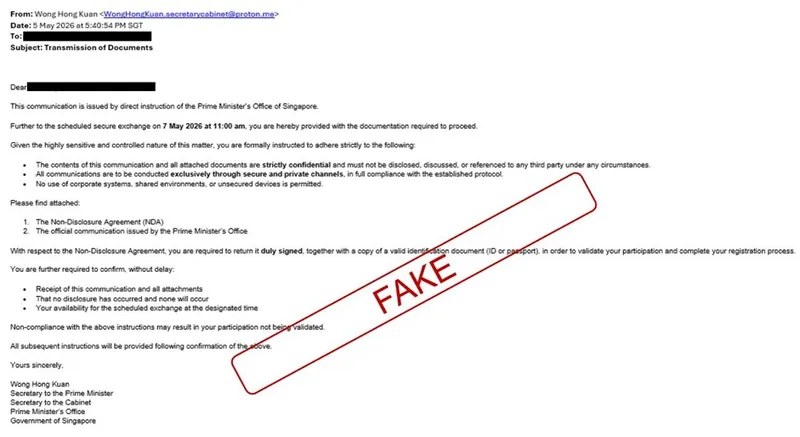
The fake email demanded that its contents remain “strictly confidential”. It also ordered: “No use of corporate systems, shared environments, or unsecured devices is permitted.” 12
Our read: secrecy was part of the trap. It cut out colleagues and normal company checks. A request to bypass your payment process should trigger more checking, not less.
The cases, compared
The Cyber Security Agency of Singapore (CSA) also records a costly overseas video-call scam. 13 The video campaigns below concern false information, not established payment losses.
| When | What happened | Who reported it | The number |
|---|---|---|---|
| May 2026 | Fake official Zoom call | Singapore police | At least S$4.9 million transferred |
| 2024 | Fake finance chief on a video call in Hong Kong | CSA and CNA | US$25 million paid |
| January–June 2026 | Business email scams | Singapore police | 262 cases; S$57.3 million lost |
| February–July 2026 reports | AI-made videos about Singapore | CNA Verify | Nearly 300 on YouTube; over 550 on TikTok; 300 fake Jack Ma videos |
What this means for you: Make independent verification a payment requirement, even when the apparent requester is important.
How cheap is it to fake a prime minister?
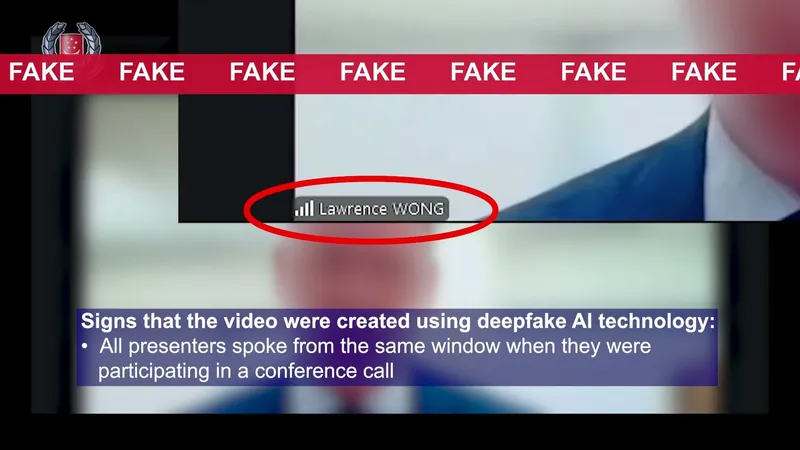
CNA traced at least seven visual segments to YouTube videos that anyone can still watch. 5 The clip used for President Tharman had fewer than 200 views; Ms Indranee’s had just over 350. 5 Our read: obscure old footage can be useful precisely because viewers are unlikely to recognise it.
The main feed stayed labelled “Lawrence Wong” throughout the call, whoever appeared on screen. Some participants’ videos played in loops. 19 One long segment was genuine: Canada’s Foreign Affairs Minister Anita Anand, speaking about the Strait of Hormuz, with audio CNA believed was likely untouched. 20 Associate Professor Reuben Ng of the National University of Singapore (NUS) called it “an exercise to erode suspicion and build trust”. 20
Jennifer Soh heads high-tech crime investigations in Asia-Pacific for the cybersecurity firm Group-IB. 21 She told CNA these scams are now “alarmingly easy to replicate”. 21 No hacking skills are needed, she said, just “a cheap voice-cloning app, and a handful of fake accounts to join the call”. 21
In her words: “You only need a laptop, a public video, and a tool that costs less than a cup of coffee”. 21 That is her estimate, not a price list. Our read: the hard part of this fraud is no longer the technology. It is getting you to act fast, and alone.
Police spotted mismatched lips and speech, audio coming through one account, and a distorted background with a partly obscured Zoom logo. 22 Those are reasons to stop. Their absence is not a reason to pay.
Omar Dapul runs DeepfAIc, an AI security firm. 23 On telling real from fake, he told Al Jazeera: “We don’t think it’s actually possible to do better than a coin toss”. 23 That is one expert’s view, not a measured rate.
Associate Professor Saifuddin Ahmed of Nanyang Technological University (NTU) calls hunting for visual flaws a “losing game”. 24 As he put it, “the content changes, but the playbook doesn’t”. 24
What this means for you: Notice suspicious details, but never make spotting them your main defence. Check the payment request elsewhere.
Why business email scams deserve your attention
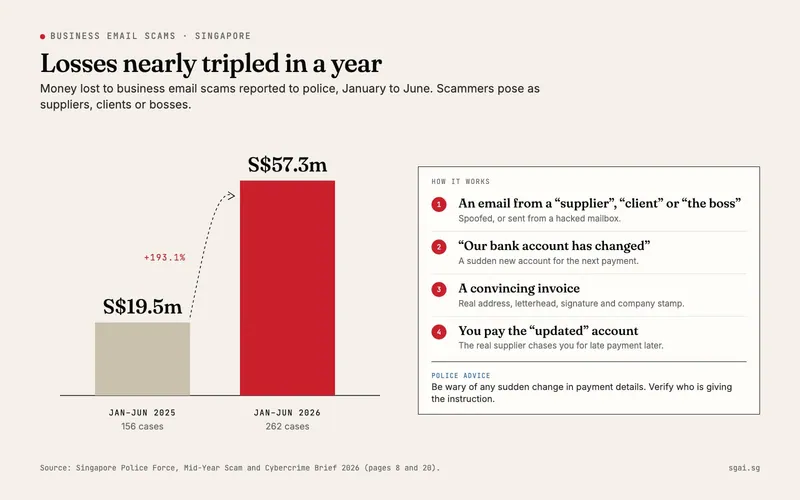
For most small firms, our view is that an ordinary payment email deserves more attention than a spectacular fake meeting.
Business email compromise means someone impersonates a supplier or colleague through misleading or hacked email accounts to redirect money. 25 Police recorded S$57.3 million lost across 262 cases in January–June 2026, with losses up 193.1% from a year earlier. 15
The familiar version is an email announcing changed bank details. Police say fraudulent invoices can carry real company addresses, letterheads, signatures and stamps. 26 A convincing document is therefore not an independent check.
Another version impersonates a boss asking staff to buy gift cards for employees or clients, sometimes moving the conversation to WhatsApp. 27 Our advice: apply the same verification rule to gift cards as bank transfers.
Our arithmetic: S$57.3 million divided by 262 cases gives an average reported loss of about S$219,000. 28 Large cases pull an average upwards; this is not a typical-case estimate. 28 Set that beside the effort of making a phone call before changing a payee.
Associate Professor Reuben Ng told CNA the impostor is usually posing as “the C-suite or people in senior management”. 29 Staff defer to rank, he said: “the power distance is quite high. So, I will tend to follow instructions and I'll tend to send this amount of money as instructed.” 29 Owners should explicitly give finance staff permission to challenge them.
Across reported scams, 80.8% involved victims making transfers themselves in the first half of 2026. 30 The payment decision, not just account security, needs protection.
Our advice: enable two-step verification on your company email, also called two-factor authentication—an extra identity check beyond a password. Hacked mailboxes are one route for these scams. 25 Still verify changed bank details separately.
What this means for you: Protect the person who pays, and make challenging an unusual instruction part of their job.
Your company name can be borrowed too
CNA Verify analysed nearly 300 AI-made YouTube videos targeting Singapore; seven in ten attacked PM Wong. 16 A separate investigation examined over 550 TikTok videos, nearly all using AI-made, manipulated or copied female presenters. 17
A third investigation found 300 YouTube videos with AI-made avatars of Alibaba founder Jack Ma. 18 Of those, 259 contained false or misleading claims, and CNA found no evidence that Mr Ma ever made the statements. 18 Our business lesson is about borrowed credibility, not proof these campaigns targeted companies.
CNA could not establish who ran the campaigns, or whether many people believed them. 31 Experts told CNA that bots or automation could explain some of the views. 16
Professor Anthony Tung of NUS put it plainly: “They are renting authority, not renting Jack Ma.” 32
Our inference: a boss’s name, a supplier’s identity or your brand can serve the same purpose. Give customers a way to verify messages before a suspicious one arrives.
Police offer a useful model. Since 2 November 2026, outgoing police calls use 6000 0999, followed by a text from the official gov.sg sender name. 33 Police say the number is used only for outgoing calls, never on WhatsApp or Telegram. 33 Copy the idea: tell customers which channels you use, and which you never use.
For short message service (SMS) texts, a sender ID is the name or number shown as the sender. Organisations that text Singapore numbers under a sender ID must register it with the Singapore Network Information Centre (SGNIC), a subsidiary of the Infocomm Media Development Authority (IMDA). Unregistered IDs are marked “Likely-SCAM”. 34
Registration costs S$545 to set up, plus S$218 a year for each sender ID. 34 Our arithmetic: one ID costs S$763 in the first year, then S$218 a year. 35 It does not replace telling customers how to check a request.
What this means for you: Publish how customers can check a message, and which channels you will never use to request payment changes.
What are police, banks and government doing?
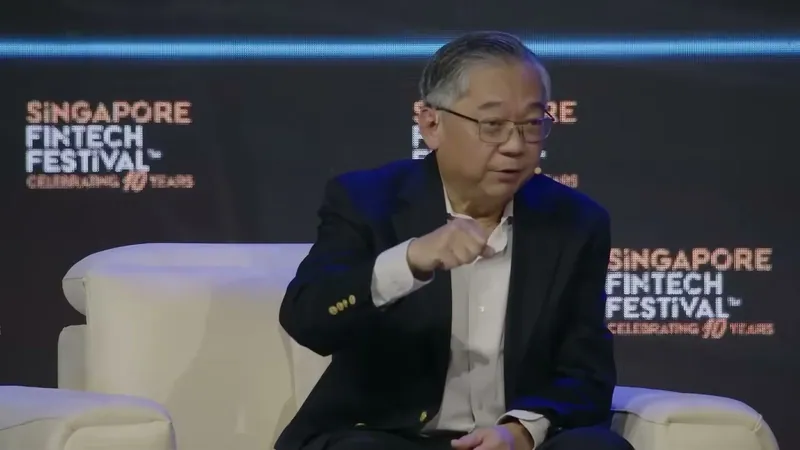
At the Singapore FinTech Festival on 18 November 2026, Deputy Prime Minister Gan Kim Yong announced three national AI missions for financial services. 36 They cover financial crime prevention, access to financing and safer transactions carried out by AI. 36
Mr Gan, who also chairs MAS, explained the problem: “A victim’s money can pass through several institutions within minutes.” 37 Our takeaway: one bank’s checks cannot be your company’s entire defence.
Who does what
Practical implications in the final column are our assessment.
| Who | What they do | What it means for you |
|---|---|---|
| Police Anti-Scam Centre | Froze more than S$97.7 million of scam funds in January–June 2026 | Report fast; frozen funds are not refunds |
| Police single caller ID | Police calls come from 6000 0999, then a gov.sg text | A model for telling customers how you contact them |
| ScamShield and 1799 | App checks suspicious contacts; helpline operates around the clock | Check before acting |
| Five unnamed banks and MAS | Trial pools data; shared-system design study starts early 2027 | Do not assume the planned system protects today’s payment |
| Government Technology Agency (GovTech) | AntiScam Pango flags suspicious chats | An extra warning, not payment approval |
| CSA, GovTech and IMDA | Consumer agent advice; CSA and IMDA also guide organisations | Separate personal use from company controls |
| SGNIC’s SMS Sender ID Registry | Registers sender IDs; unregistered IDs receive a warning label | Register branded texts and publish verification instructions |
The five banks, which have not been named, pool transaction data so AI can spot patterns no single bank sees. 41 What they learn will shape an industry-wide Scam Detection Utility. 41 It does not exist yet: MAS starts designing it in early 2027. 41
ScamShield’s helpline receives around 500 calls daily, mostly from people checking whether something is a scam. 47 Calling before payment is a sensible use of it.
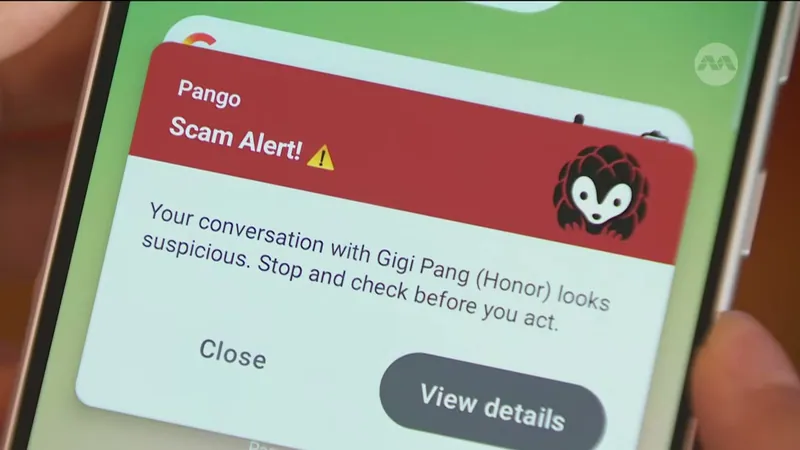
GovTech launched AntiScam Pango, a free app built with help from Google DeepMind, as a beta (test) version on 4 November. 4248 It is Android-only, works in English for now, and checks WhatsApp, Telegram and SMS—not email or other messaging platforms. 4249 It warns but cannot block or delete messages. 48
Google Play showed “1K+” downloads on 21 November, a download band rather than an exact user count. 43 Our advice: treat it as another warning layer, not a safety certificate.
What this means for you: Use the available help, but keep your own callback and approval checks.
Can an AI assistant be tricked into paying?
An AI agent is software that can take actions for you, rather than merely write an answer. Depending on its permissions, it can also expose information or take unintended actions. 44
On 6 November 2026, CSA, GovTech and IMDA issued a five-step consumer advisory. 4450515253 It warns that “you cannot treat them like human assistants”. 54 Scammers may target the agent through instructions hidden in emails, documents or websites instead of persuading you. 52
On responsibility, the advisory is direct: “You remain responsible for how you use AI agents, including the actions these agents take on your behalf”. 55 Users may also be held liable, depending on the circumstances and applicable laws; liability is not automatic. 55
This is guidance for individuals, not a new law. For a business, the firmer rules are in CSA’s advisory on the OpenClaw agent and in IMDA’s framework for AI agents. 4546
What the AI-agent rules ask of a business
| Rule or principle | Who said it | What to do in practice |
|---|---|---|
| Keep permissions narrow | Joint consumer advisory | Give access only to the task needed |
| Keep agents out of bank accounts; never share passwords or one-time passwords | Joint consumer advisory | Keep payment logins with people |
| Prefer one-time approvals | Joint consumer advisory | Avoid permanent permission for consequential actions |
| Require human approval for financial transactions | CSA’s OpenClaw advisory | Enforce approval through system controls |
| Humans remain ultimately accountable | IMDA framework | Name an owner and approval checkpoints |
| Log every agent action | CSA’s OpenClaw advisory | Check the activity log regularly |
| Enterprises remain accountable | DPM Gan, MAS keynote | Do not treat automation as a transfer of responsibility |
What to check before connecting an assistant: keep it away from banking accounts. Never provide passwords or one-time passwords (OTPs), the temporary codes used to approve access or actions. 50
Set limits in the app’s permission settings, not merely in chat instructions. 51 For company payments, CSA recommends human approval enforced by system controls—not just asking the agent to behave. 45
What this means for you: Let an assistant prepare work without giving it independent authority to move money.
Who pays if your company is scammed?
Singapore’s Shared Responsibility Framework (SRF) covers specified phishing losses on qualifying accounts held by individuals—not accounts held in a company’s name. 5758 Here, phishing involves fake websites or apps obtaining login details that scammers use for unintended transactions. 58
Banks also have discretionary goodwill frameworks for scam victims. 57 Discretionary help is not a promised refund.
Our budgeting advice: assume the loss is yours. Ask your bank in writing what protection applies to your company account, changed-payee fraud and payments staff were deceived into approving.
What this means for you: Prevention belongs in your payment process; reimbursement should not be your backup plan.
What to do now
These are our four rules, built on official verification advice—not government requirements. 11395960
- Never pay solely on the strength of a call, video, email or chat.
- Call back on a number you already have, not one supplied in the new request.
- Require two people to approve any new or changed payee.
- Tell customers how to check that a message really comes from you.
If someone asks you to pay
The responses below are our suggested process, drawing on the cited official advice.
| The request | The red flag | What to do |
|---|---|---|
| Supplier emails new bank details | Changed payment destination | Call the saved supplier number; require another approver |
| Boss requests urgent, confidential payment | Pressure to bypass checks | Verify outside that conversation; apply the usual approval rule |
| Senior person or official asks for money on video | Appearance treated as proof | Do not pay; hang up and call back on a number you already have |
| Gift cards for staff or clients | Unusual purchasing instruction | Check with the boss separately before buying |
| Known contact requests money or an OTP | Familiar account, unusual request | Call their usual number or check in person |
| AI assistant wants to pay or access the bank | Excessive permissions | Keep banking access closed; require human approval |
| Money already sent | Possible fraud | Call your bank’s official hotline now; report to police; call 1799 if unsure |
Finance staff: keep this table beside the payment process. A senior name should not cancel the check.
Owners: tell staff they will not be penalised for verifying your instructions. Make the second approval meaningful: the approver should inspect the independent confirmation.
Firms sending invoices or texts: publish a verification number and explain how bank-detail changes are confirmed. Put the same instructions on invoices and your website.
Firms trying AI agents: start with drafting or read-only work. Test how to revoke access before permitting consequential actions. 5451
We also made a short reel on the fake Zoom call: watch it on Instagram.
What this means for you: Make verification routine before the next urgent request arrives. A believable face should never be enough to release money.
Questions Singapore business owners are asking
Was the fake Lawrence Wong Zoom call entirely AI-generated?
No. Police said some portions were edited using deepfake AI technology. CNA examined the full recording and found it was built mostly from real public videos mixed with doctored audio and other alterations. The practical lesson is that scammers do not need to generate an entire meeting from scratch. Verify payment requests independently, rather than judging the video alone.
What should my finance team do when a supplier changes bank details?
Police identify changed supplier bank details as a prominent business email scam. Fraudulent invoices may carry genuine company letterheads, addresses and stamps. Our advice is to call the supplier using a number already in your records, confirm the change outside the email conversation, and require another person to approve the new payment destination. Do not use contact details supplied only in the change request.
Does AntiScam Pango block scam messages or work on iPhone?
No. GovTech’s free AntiScam Pango app warns about suspicious conversations but cannot block or delete messages. It is Android-only and works in English for now. It checks WhatsApp, Telegram and SMS, not email or other messaging services. Treat an alert as a reason to verify independently. Do not treat the absence of an alert as permission to pay.
Will my bank refund my company after a scam?
Do not assume so. Singapore’s Shared Responsibility Framework covers specified phishing losses on qualifying accounts held by individuals; accounts in a company’s name are outside its definition. Banks also have discretionary goodwill frameworks, but those are not guaranteed refunds. Ask your bank in writing about your business account and the relevant scam circumstances. Report suspected fraudulent transactions immediately.
Is it safe to let an AI assistant make business payments?
Our advice is not to give it independent payment authority. The consumer advisory says to avoid banking access and never share passwords or one-time passwords with an agent. For organisations, CSA’s OpenClaw advisory recommends human approval for financial transactions, enforced through system controls. A chat instruction telling the assistant to ask first is not an adequate substitute for those controls.
How much does registering an SMS sender ID cost in Singapore?
SGNIC charges S$545 to set up an account and S$218 a year for each registered SMS sender ID, including GST. Our arithmetic puts one sender ID at S$763 in the first year and S$218 a year afterwards. Unregistered sender IDs appear as “Likely-SCAM”. Registration is required if you text Singapore numbers under a sender ID, but customers should still have a separate way to verify payment requests.
Sources
- [1]Police Advisory On Scams Involving The Impersonation Of Senior Government Officials — Singapore Police Force, 2026-05-14
- [2]Footage From Zoom Video Conference Involving Impersonation Of Senior Government Officials — Singapore Police Force, 2026-05-16
- [3]Police Advisory On Scams Involving The Impersonation Of Senior Government Officials — Singapore Police Force, 2026-05-14
- [4]How scammers built a fake Zoom call from real videos of PM Wong and other Singapore leaders — CNA, 2026-08-22
- [5]How scammers built a fake Zoom call from real videos of PM Wong and other Singapore leaders — CNA, 2026-08-22
- [6]Police Advisory On Scams Involving The Impersonation Of Senior Government Officials, Including Secretary To The Cabinet — Singapore Police Force, 2026-05-14
- [7]Police Advisory On Scams Involving The Impersonation Of Senior Government Officials — Singapore Police Force, 2026-05-14
- [8]Police Advisory On Scams Involving The Impersonation Of Senior Government Officials — Singapore Police Force, 2026-05-14
- [9]Footage From Zoom Video Conference Involving Impersonation Of Senior Government Officials — Singapore Police Force, 2026-05-16
- [10]Police Advisory On Scams Involving The Impersonation Of Senior Government Officials — Singapore Police Force, 2026-05-14
- [11]Footage From Zoom Video Conference Involving Impersonation Of Senior Government Officials — Singapore Police Force, 2026-05-16
- [12]Annex B, Email Received by the Victim — Singapore Police Force, 2026-05-14
- [13]Advisory on Detecting and Responding to Deepfake Scams — Cyber Security Agency of Singapore, 2024-03-22
- [14]How scammers built a fake Zoom call from real videos of PM Wong and other Singapore leaders — CNA, 2026-08-22
- [15]Mid-Year Scam and Cybercrime Brief 2026 — Singapore Police Force, 2026
- [16]Singapore and PM Lawrence Wong targeted in AI-driven disinformation campaign on YouTube — CNA, 2026-02-25
- [17]AI-generated women are spreading disinformation about Singapore on TikTok — CNA, 2026-07-13
- [18]Some 260 fake Jack Ma videos spreading falsehoods about Singapore on YouTube: CNA investigation — CNA, 2026-07-28
- [19]How scammers built a fake Zoom call from real videos of PM Wong and other Singapore leaders — CNA, 2026-08-22
- [20]How scammers built a fake Zoom call from real videos of PM Wong and other Singapore leaders — CNA, 2026-08-22
- [21]How scammers built a fake Zoom call from real videos of PM Wong and other Singapore leaders — CNA, 2026-08-22
- [22]Footage From Zoom Video Conference Involving Impersonation Of Senior Government Officials — Singapore Police Force, 2026-05-16
- [23]Singapore AI fraud: Rise of deepfake videos to scam people — Al Jazeera English, 2026-08-23
- [24]AI-generated women are spreading disinformation about Singapore on TikTok — CNA, 2026-07-13
- [25]Mid-Year Scam and Cybercrime Brief 2026 — Singapore Police Force, 2026
- [26]Mid-Year Scam and Cybercrime Brief 2026 — Singapore Police Force, 2026
- [27]Mid-Year Scam and Cybercrime Brief 2026 — Singapore Police Force, 2026
- [28]SGAI arithmetic on Mid-Year Scam and Cybercrime Brief 2026 figures — Singapore Police Force, 2026
- [29]Singapore reports fewer scams, lower monetary losses in H1 — CNA, 2026-08-26
- [30]Mid-Year Scam and Cybercrime Brief 2026 — Singapore Police Force, 2026
- [31]CNA Explains: Why Singapore is a prime target for disinformation campaigns — CNA, 2026-11-11
- [32]Some 260 fake Jack Ma videos spreading falsehoods about Singapore on YouTube: CNA investigation — CNA, 2026-07-28
- [33]Know Who's Calling: SPF Launches Single Caller ID to Combat Scams — Singapore Police Force, 2026-11-01
- [34]Overview of SMS Sender ID Registry — SGNIC, 2026-11-21
- [35]SGAI arithmetic on Overview of SMS Sender ID Registry fees — SGNIC, 2026-11-21
- [36]Ministerial Keynote by Mr Gan Kim Yong at the Singapore FinTech Festival 2026 — Monetary Authority of Singapore, 2026-11-18
- [37]Ministerial Keynote by Mr Gan Kim Yong at the Singapore FinTech Festival 2026 — Monetary Authority of Singapore, 2026-11-18
- [38]Mid-Year Scam and Cybercrime Brief 2026 — Singapore Police Force, 2026
- [39]Police Advisory On Scams Involving The Impersonation Of Senior Government Officials — Singapore Police Force, 2026-05-14
- [40]GovTech Launches AntiScam Pango Beta to Help Users Spot Suspicious Scam Messages — GovTech Singapore, 2026-11-04
- [41]Ministerial Keynote by Mr Gan Kim Yong at the Singapore FinTech Festival 2026 — Monetary Authority of Singapore, 2026-11-18
- [42]GovTech Launches AntiScam Pango Beta to Help Users Spot Suspicious Scam Messages — GovTech Singapore, 2026-11-04
- [43]AntiScam Pango — Google Play, 2026-11-21
- [44]Joint Advisory: Using Personal AI Agents Safely and Securely — Cyber Security Agency of Singapore, 2026-11-06
- [45]Advisory on Cybersecurity Risks of OpenClaw — Cyber Security Agency of Singapore, 2026-05-28
- [46]Singapore Launches New Model AI Governance Framework for Agentic AI — IMDA, 2026-01-22
- [47]Mid-Year Scam and Cybercrime Brief 2026 — Singapore Police Force, 2026
- [48]GovTech Launches AntiScam Pango Beta to Help Users Spot Suspicious Scam Messages — GovTech Singapore, 2026-11-04
- [49]About the app — AntiScam Pango FAQ, GovTech, 2026-11-12
- [50]Joint Advisory: Using Personal AI Agents Safely and Securely — Cyber Security Agency of Singapore, 2026-11-06
- [51]Joint Advisory: Using Personal AI Agents Safely and Securely — Cyber Security Agency of Singapore, 2026-11-06
- [52]Joint Advisory: Using Personal AI Agents Safely and Securely — Cyber Security Agency of Singapore, 2026-11-06
- [53]Joint Advisory: Using Personal AI Agents Safely and Securely — Cyber Security Agency of Singapore, 2026-11-06
- [54]Joint Advisory: Using Personal AI Agents Safely and Securely — Cyber Security Agency of Singapore, 2026-11-06
- [55]Joint Advisory: Using Personal AI Agents Safely and Securely — Cyber Security Agency of Singapore, 2026-11-06
- [56]Ministerial Keynote by Mr Gan Kim Yong at the Singapore FinTech Festival 2026 — Monetary Authority of Singapore, 2026-11-18
- [57]MAS and IMDA Announce Implementation of Shared Responsibility Framework from 16 December 2024 — Monetary Authority of Singapore, 2024-10-24
- [58]Guidelines on Shared Responsibility Framework — Monetary Authority of Singapore, 2024-10-24
- [59]Mid-Year Scam and Cybercrime Brief 2026 — Singapore Police Force, 2026
- [60]Usage — AntiScam Pango FAQ, GovTech, 2026-10-30
How this was made. SGAI's desk picks the story and the Singapore angle and gathers the primary sources. An AI model drafts from those sources only. Every figure is checked against the linked source before Jay Qin reviews and publishes. Spotted an error? Email jay@sgai.sg and we will correct it here, in the open.