Singapore's Agentic AI Governance Framework: A Practical Guide for SMEs
In January 2026, Singapore became the first country in the world to publish a governance framework built specifically for agentic AI — systems that don't just answer questions, but take actions on your behalf. Here is what IMDA's framework means for your business, in plain language and practical steps.
What Makes Agentic AI Different
A generative AI tool writes a draft email. An agentic AI system sends it — and may also pull the customer's record, apply a discount, and schedule a follow-up, chaining several tools together with limited human input.
That autonomy is exactly what makes agents valuable for a lean SME — and exactly what raises the stakes:
- A wrong answer is a bad output you can catch before it matters.
- A wrong action is a refund issued, data shared, or a message sent — already done.
Governance for agents is therefore about bounding what an agent is allowed to do, not just checking what it says.
Where This Fits in Singapore's AI Governance Stack
Singapore has built its AI governance in deliberate layers, and the agentic framework builds on — it does not replace what came before:
- 2019/2020 — Model AI Governance Framework: the foundational principles for traditional AI.
- 2024 — Model AI Governance Framework for Generative AI: a nine-dimension playbook for the GenAI era.
- 2026 — Model AI Governance Framework for Agentic AI: the new layer for autonomous agents.
This is the “Singapore way” in practice: the government acting as a long-term partner that gives industry a clear, voluntary playbook to build on — shaped, in this case, with input from more than 60 companies.
The Four Dimensions — and What Each Means for Your Business
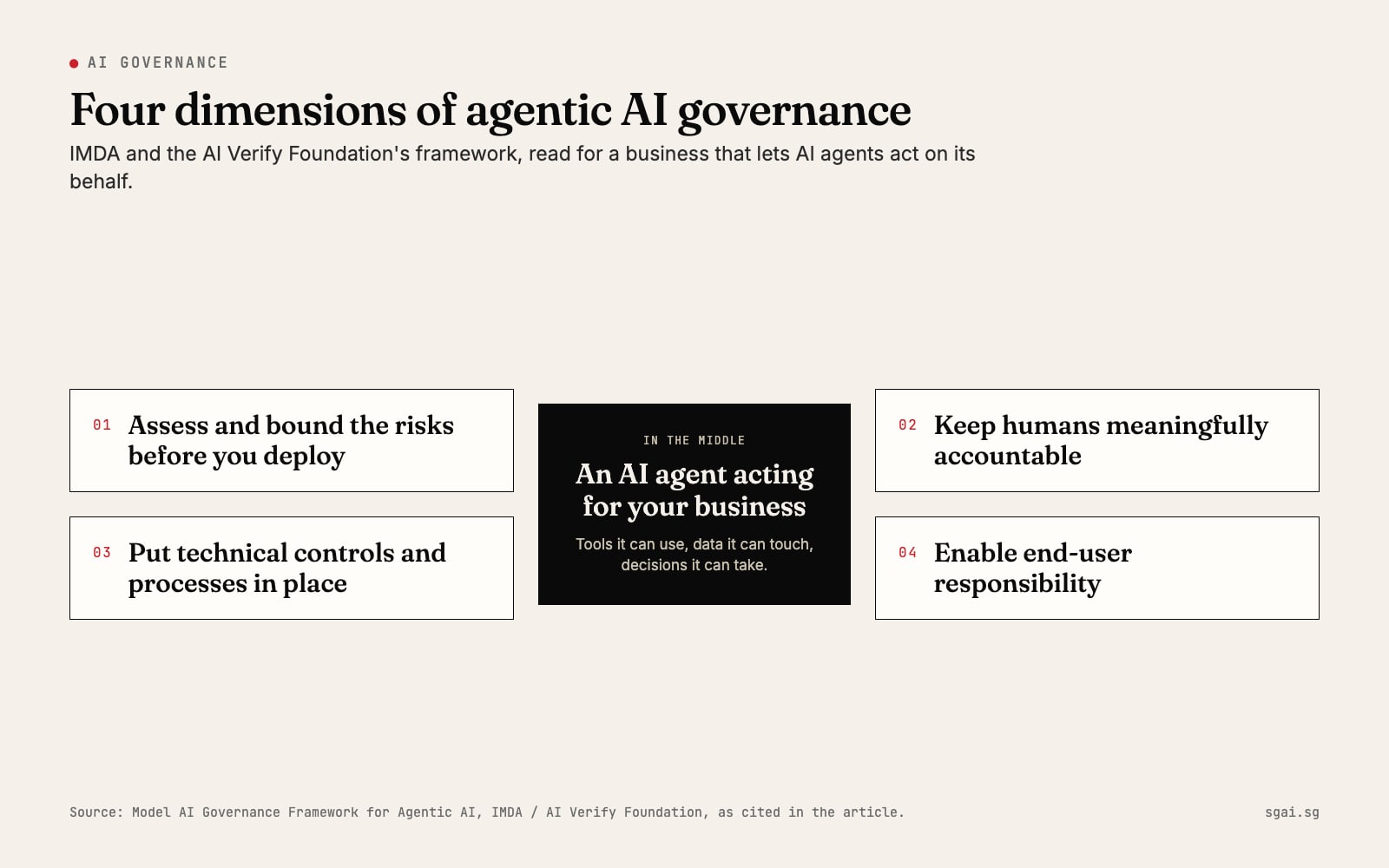
The framework centres on four areas. Here is each one, with what it asks and what an SME can actually do about it.
1. Assess and bound the risks before you deploy
What it means: decide, up front, how much autonomy an agent should have — and cap its access accordingly.
- Limit each agent's tool access (e.g. it can read orders but not issue refunds above a set amount).
- Limit its data access to only what the task genuinely needs.
- Set clear thresholds where the agent must stop and ask a human.
2. Keep humans meaningfully accountable
What it means: a named person stays responsible — “the AI did it” is never an answer.
- Assign a human owner for every deployed agent.
- Define which actions require human approval before execution.
- Make sure staff understand what the agent can and cannot do.
3. Put technical controls and processes in place
What it means: build the guardrails, logging, and testing that let you catch and contain failures.
- Log every action an agent takes, so you can audit and roll back.
- Test agents for failure modes before go-live — Singapore's free, open-source AI Verify and Project Moonshot toolkits are built for exactly this.
- Add monitoring and a clear “stop” control.
4. Enable end-user responsibility
What it means: the people interacting with the agent should know they are dealing with one, and how to flag problems.
- Disclose clearly when a customer is interacting with an AI agent.
- Give users an easy route to a human and a way to report issues.
- Keep your terms and consent honest about what the agent does with data.
How to Start This Week — Without a Compliance Department
You do not need a legal team to begin. Three concrete moves, all using free national resources:
- Read the framework. It is a free download from IMDA and the AI Verify Foundation — a few hours that will reshape how you scope your next AI build.
- Map one agent you are already building against the four dimensions above. Where can it act? What can it touch? Who is accountable?
- Test it. Run it through AI Verify or Project Moonshot before it ever touches a real customer.
Why This Is an Edge, Not a Cost
For a Singapore SME, governance is not red tape — it is how you win the work. Larger clients, and especially government buyers, increasingly ask how your AI is governed before they will deploy it. Being able to say “our agents are built to IMDA's Agentic AI governance framework and tested with Singapore's national tooling” turns a compliance checkbox into a reason to trust you.
Singapore's stated ambition is to lead the world in deploying AI for real use cases — not in hype. The businesses that can deploy it responsibly are the ones that get to deploy it at all. Pair good governance with the right funding — see our complete guide to Singapore AI grants.
Building AI Agents Your Customers Can Trust?
We build bespoke AI for Singapore businesses — governed to IMDA's frameworks and tested with the national tooling, so it is safe to put in front of customers from day one.
Free 2-minute assessment. No sign-up required.
Start the assessmentOfficial References
This article is a practical summary. Always refer to the official framework for the authoritative text, and verify details with the relevant agency.