Punggol self-driving shuttle near miss and hard braking: what businesses can learn
The near miss, U-turn and older braking clip deserve a fair hearing. Singapore’s safeguards offer a practical lesson: a trained human, an untouched record and a prompt account of what happened.
A Grab self-driving shuttle came close to a schoolgirl at a Punggol crossing on 5 November 2026. 12 How that moment was handled is a lesson for any business putting artificial intelligence (AI) in front of customers.
A safety operator, the trained person on board who can take over the driving, stepped in. 34 The Land Transport Authority (LTA) had the vehicle's data to review and gave its first account the next day. 56
Our read: this shows why safeguards belong around automation, not only inside it. It does not settle whether the shuttle's own driving was good enough. That is for LTA's investigation to decide. 7
For a business, the useful test is simple. Can someone stop the system, reconstruct what it did and explain what happened?
What happened in Punggol on 5 November?
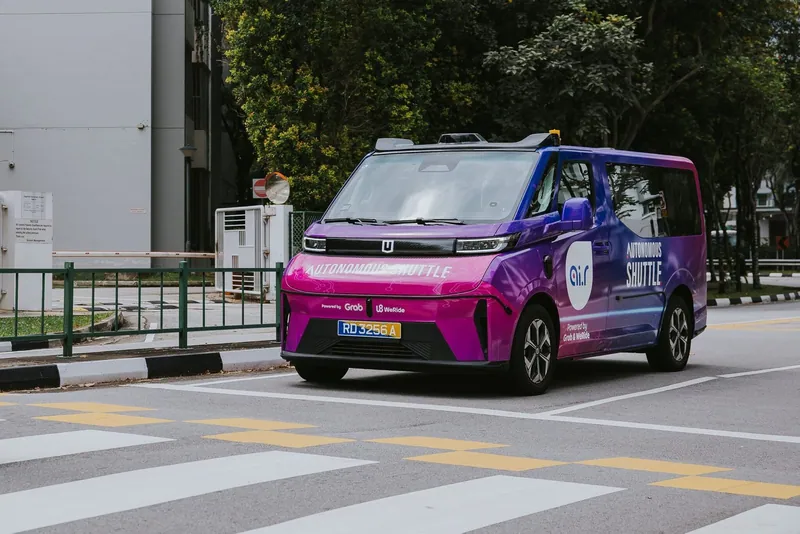
At around 8.11am, a Grab shuttle came close to a schoolgirl while turning left on a green light. 18 Grab's shuttles use technology from WeRide, an autonomous vehicle (AV) company. 9
LTA's preliminary account says the vehicle detected both pedestrians and kept tracking their movements. 6 After the traffic light turned green, it began turning left. When the child began crossing, it braked and steered right. 8 The safety operator then took control and kept braking and steering away from her. 3
That is not the same as saying the shuttle failed to see her. Nor does detection alone settle whether its response was good enough. LTA said it would review whether the response to such scenarios should be adjusted. 7
LTA directed Grab to pause testing at such junctions until investigations are completed. 7 The direction was narrow: it covered testing at junctions like this one. 7 Grab said: "Safety is our top priority. We are aware of this incident and are closely reviewing it together with the Land Transport Authority and our partner WeRide." 10
Later that morning, at about 10am, a ComfortDelGro shuttle making a U-turn in Punggol Field nearly hit an oncoming vehicle. 11 LTA directed ComfortDelGro to pause U-turns at that junction pending its review. 12 ComfortDelGro said it was looking into the matter with its technology partner and LTA. 13
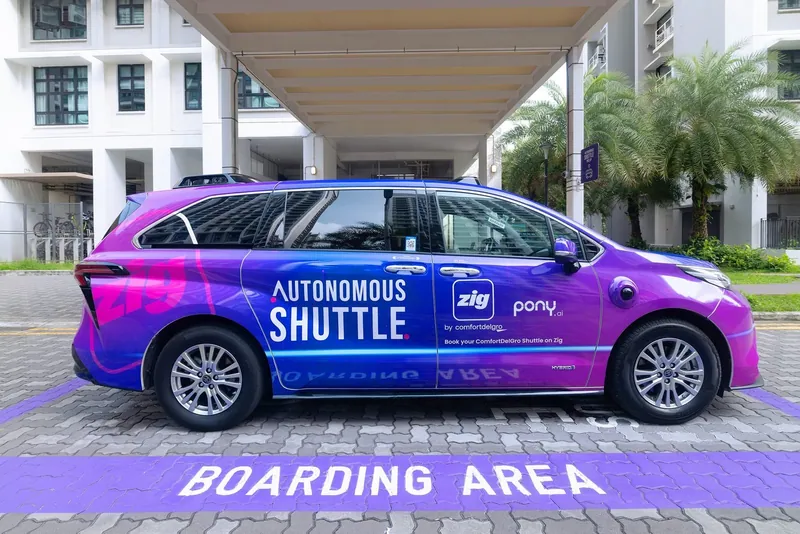
Both vehicles were testing new routes for on-demand services, not running their established fixed shuttle routes. 14 An on-demand route is booked by the rider. In Grab's planned version, the vehicle takes the most direct route between chosen stops instead of a fixed loop. 1516
What this means for you: Success on a familiar task is not clearance for a new one. Test the changed conditions before you expand.
What does the August dashcam clip show?
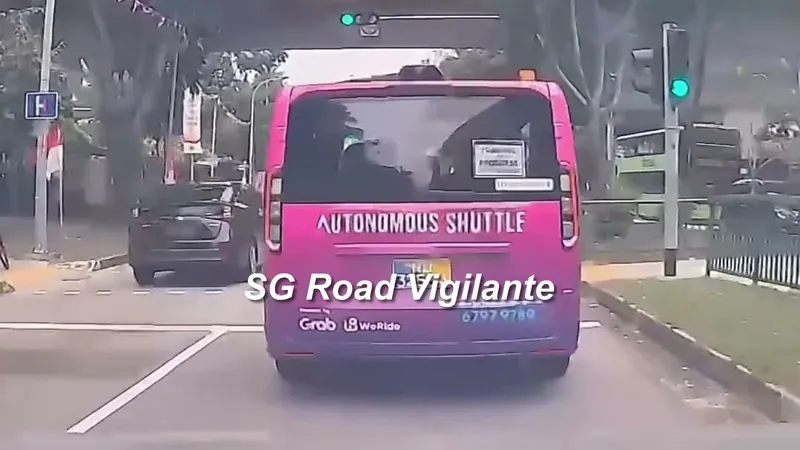
Separate the filming date from the upload date. The Punggol Field clip was filmed on 13 August 2026 and posted online on 9 November, after the schoolgirl video appeared on social media. 1718 It is not another November incident.
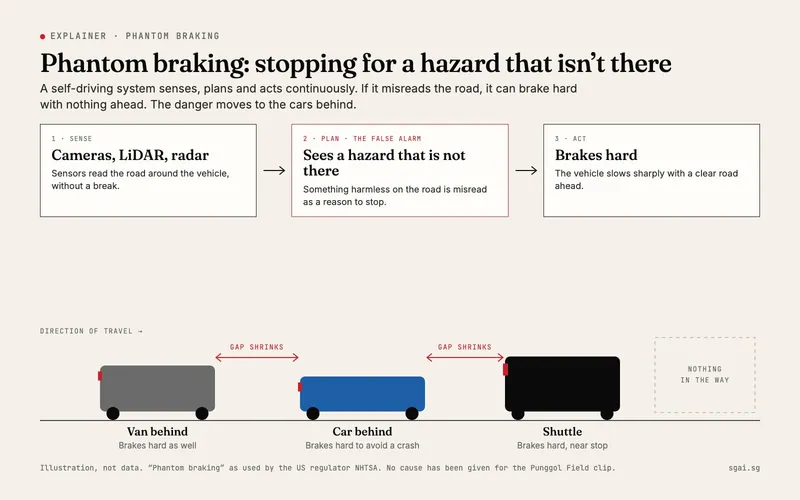
The footage shows a Grab and WeRide shuttle braking almost to a stop under a green light. Nothing appears to be in its way. 171920 The car filming it brakes hard, and so does a van behind that car. 20 The video shows no contact between the vehicles. 17
The driver who filmed it says in the caption: "lucky i kept a safe distance & the driver behind me was alert too". 21 So the risk sat behind the shuttle, with the traffic following it.
If you drive in Punggol, LTA says a blinking yellow beacon on top means the vehicle is in autonomous mode. 22 Our advice: leave extra room behind it.
Grab's and LTA's later statements are general. LTA said: "We are reviewing the incidents with the respective AV operators to establish the circumstances and identify any necessary improvements." 23 Grab said its safety operators "are on board at all times to step in when needed". 24 Neither explains the August braking. 25
Who says what
| Voice | What they said | Source type | Our reading |
|---|---|---|---|
| LTA | Reviewing the incidents "to establish the circumstances". | Official statement to Mothership | Not a final finding. |
| Grab | "Safety is our top priority." Safety operators are on board at all times. | Company statements to the press | Reassurance, not an explanation of the braking. |
| ComfortDelGro | "We take safety seriously and will assess the circumstances thoroughly." | Company statement to Mothership | A review was promised. |
| WeRide | No public statement found by 21 November 2026. | Our search, not a company statement | Its own account is unknown. |
| Video posters | Allege a failure to give way on 5 November, and say the August shuttle braked "for no reason". | The posters' own titles and captions | Descriptions, not findings. |
| Punggol residents | Worried, but largely supportive of trials continuing. | Interviews by CNA | Concern is not rejection. |
| Transport Minister Jeffrey Siow | Expansion will be careful, "only when we are confident that it is safe". | Official speech, 18 September 2026 | An intention, not a guarantee. |
What this means for you: Separate recordings, allegations and findings. An old video going viral does not make it a new incident.
What is "phantom braking", and is that what happened?
"Phantom braking" is the informal name for a car slowing sharply on its own, when its automated system brakes for a hazard that is not there. 3031
Consumers often used the term in complaints to the United States road-safety regulator, the National Highway Traffic Safety Administration (NHTSA). 32 It opened an investigation into Tesla cars in February 2022 after 354 such complaints. 32 Drivers typically reported seeing no vehicles ahead that would explain the braking. 31 NHTSA closed the case on 29 June 2026 "without a manufacturer action", and said this "does not constitute a finding" that no defect exists. 3033
That case concerns driver-assistance features in private cars, not Punggol's shuttles. 3233 It explains the term; it does not diagnose this clip.
LTA describes self-driving as a repeating cycle: sense the surroundings, plan a path, then act. 34 The sensors include cameras and LiDAR, short for Light Detection and Ranging: laser sensors that measure distance. 34 If the sensing or planning step mistakes something harmless for a hazard, the acting step can be a hard brake.
There is a documented Punggol false alarm, but it belongs to a different case. In January 2026, LTA's review of a ComfortDelGro test vehicle's minor collision found it "detected an object that was not on the road". 35 That finding cannot be carried over to the August clip.
We do not know whether anything similar happened on Punggol Field. No cause had been given by 21 November 2026. 25 LTA's review and the vehicle's recorder data are what would settle it.
What this means for you: Describe the behaviour before you name a fault. A confident label can outrun the evidence.
What do Singapore's rules require of self-driving vehicles?
The binding rules are the Road Traffic (Autonomous Motor Vehicles) Rules 2017, in force since 24 August 2017. 36 A vehicle needs LTA's authorisation before it is used on a road. 36 Permission comes with conditions; it is not an open licence. 437
LTA calls the vehicle's recorder a "blackbox": a running diary kept for investigators. 3839 It must keep recording even when a person is driving. 40 Its data must not be edited. Breaking that rule carries a fine of up to S$5,000, five times the first-offence cap for the other recorder duties. 41
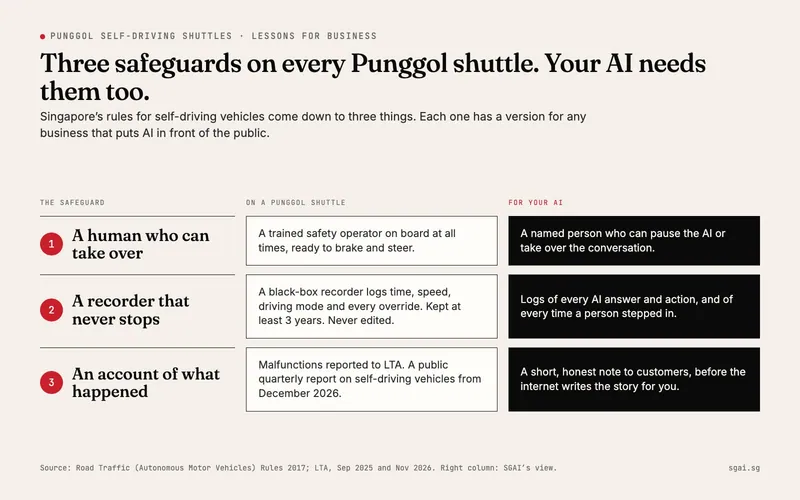
What the rules require, and the business version
The last column is our advice, not a claim that vehicle law applies to chatbots.
| Rule | On a Punggol shuttle | For your AI: our view |
|---|---|---|
| Permission | LTA authorisation needed before road use. | Approve a defined task and scope. |
| A human backstop | LTA can require a safety operator; Punggol's are on board at all times. | Name someone who can stop it. |
| Continuous recording | Always on; data kept at least three years. | Keep a protected record, with clear retention rules. |
| Untouched records | No editing; override history captured and shared with LTA. | Keep originals; log corrections separately. |
| Reporting | Malfunctions and accidents reported to LTA as it requires. | Set an escalation and explanation process. |
| Insurance | Liability insurance in place before trials start. | Check who is responsible, and your cover. |
| Suspension | LTA can suspend or cancel permission. | Be able to pause the affected function. |
Before deployment, vehicles must pass safety assessments at the CETRAN test centre (Centre of Excellence for Testing and Research of AVs-NTU). 38 Readiness also means driving enough distance on the actual route without the safety operator stepping in, according to the Ministry of Transport (MOT). 44
Technical Reference 68 (TR 68) is a set of industry guidelines, first published in 2019, not the binding road rules. 4546 MOT said on 7 May 2026 that it is being reviewed. 45 Keep guidance and legal duties separate when you check a supplier's promises.
What happened, when
| Date | Development | Why it matters |
|---|---|---|
| 24 August 2017 | Rules for self-driving vehicles take effect. | Oversight predates these videos. |
| 20 September 2025 | LTA announces three Punggol shuttle routes, with Tengah in view. | The plan was to start small. |
| 17 January 2026 | A ComfortDelGro test vehicle has a minor collision after a takeover. | The handover needs scrutiny. |
| 1 April 2026 | Public shuttle rides begin. | Trials move to public use. |
| 29 July 2026 | LTA announces Grab's on-demand pilot. | New routes need testing. |
| 13 August 2026 | Punggol Field braking clip filmed. | Keep the incident date straight. |
| 5 November 2026 | Schoolgirl near miss; separate U-turn incident. | Both were on new routes. |
| 6 November 2026 | LTA gives its account and pauses testing at such junctions. | An early, factual account. |
| 9 November 2026 | August clip posted online. | Upload date is not incident date. |
| December 2026 (promised) | First quarterly report on self-driving vehicles due. | Look beyond single videos. |
LTA says the quarterly reports are meant "to ensure transparency and strengthen public confidence in AVs as we scale up". 50 Our view: regular numbers give the public something firmer than reassurance.
What this means for you: Borrow the discipline, not the vehicle paperwork. Permission, records and a way to stop should come before expansion.
Why does the human handover matter so much?
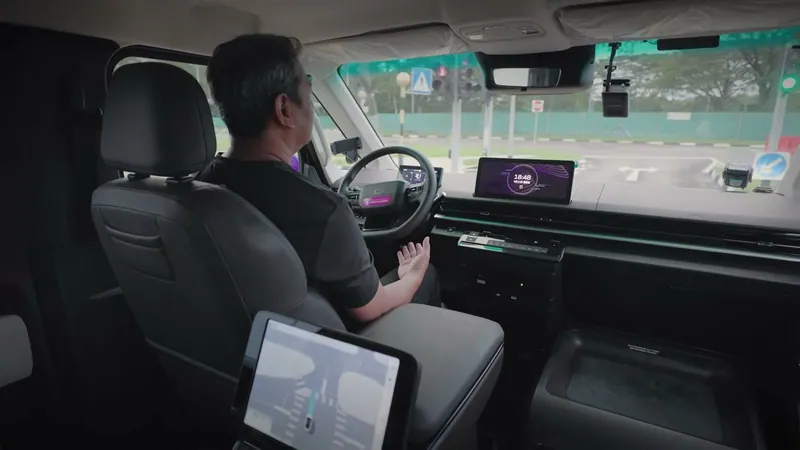
Grab says safety operators are on board at all times. 24 LTA's Punggol plan says the same for trials and commercial service. 42 Do not picture an empty driver's seat.
Grab says the training covers switching between self-driving and manual control, emergency procedures and troubleshooting. 51 Senior Minister of State for Transport Sun Xueling said it required a 90% passing score. 52 The business version is rehearsing the takeover, not just naming somebody in a policy.
January's Edgedale Plains case shows why this is hard. A ComfortDelGro test vehicle detected an object that was not on the road and moved into the next lane. LTA said it did this correctly, as a precaution. 35
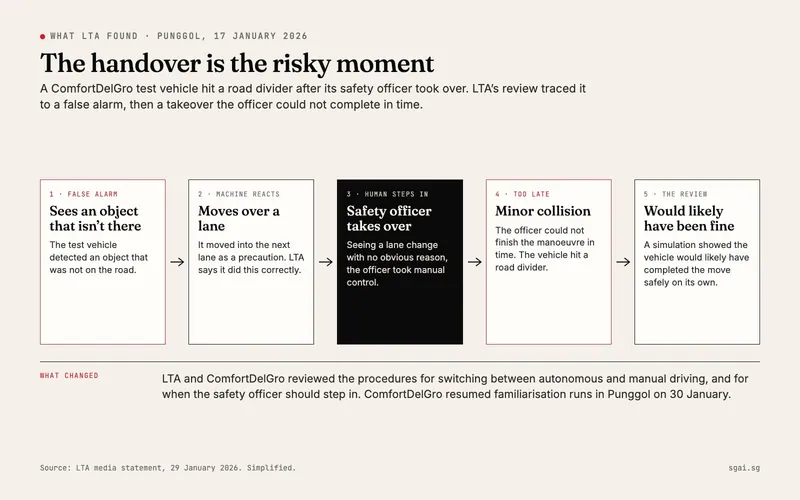
Seeing a lane change with no obvious reason, the safety officer took over. That ended autonomous mode, the setting in which the vehicle drives itself. 48 The officer could not complete the manoeuvre in time, and the vehicle hit the road divider. 48
Do not turn that into blame for one person. LTA said a simulation, a computer reconstruction, showed the vehicle would likely have completed the manoeuvre safely without the takeover. 53 LTA and ComfortDelGro then reviewed the procedures for switching between autonomous and manual driving, and for when the officer should step in. 54 Familiarisation resumed on 30 January 2026. 54
Singapore's AI guidance also warns about automation bias: trusting a system too much because it has worked well before. 55 Our view: blind trust and an unpractised takeover are both risks. Staff need clear signals, the right information and a working way to stop the system.
What this means for you: A person nearby is not enough. Practise when they should step in, and what happens when they do.
What happens next for Punggol and other towns?
On 18 September 2026, Transport Minister Jeffrey Siow outlined plans for point-to-point service across Punggol, without fixed routes. 56 He named Tampines North and Tengah as possible next towns, and said Waymo would begin testing and preparations around Labrador and Harbourfront. 56 Treat these as plans, not services already running.
He also said Singapore had 16 passenger vehicles, all in Punggol, and expected several hundred within two years. 57 On safety, he said the vehicles had gone more than 160,000 km "without a major accident, albeit only on fixed routes". 29 Both November near misses happened while testing new routes. 14
Public confidence needs careful reading too. LTA said 99% of around 900 riders surveyed in July felt safe and would recommend the ride. 16 Those are rider opinions, not an accident rate.
CNA's 9 November report, based on interviews with 12 Punggol residents, found concern, especially among parents of young children. 28 The residents were still largely supportive of trials continuing. 28
On 4 March 2026, Sun Xueling said a fuller legal framework for these vehicles was being developed, to spell out who is responsible for what. 58 Our parallel for businesses: settle responsibility before you expand.
What this means for you: Customer confidence matters, but it does not prove every new situation is safe. Scale on evidence, not enthusiasm.
What should a business using AI learn from Punggol?
Our recommendation is to borrow the three safeguards: a practised human takeover, an untouched record and an early, factual explanation.
Singapore's Model AI Governance Framework, from the Infocomm Media Development Authority (IMDA) and the Personal Data Protection Commission (PDPC), describes three levels of human control. 59 The right level depends on how likely harm is and how serious it would be. 60 Spend your supervision where mistakes would hurt most.
Your options, compared
The Punggol comparisons and suggested uses are our interpretation, not official labels.
| Approach | The framework's example | Punggol comparison | Our suggested use |
|---|---|---|---|
| Human-in-the-loop: a person keeps control and makes the decision. | A doctor makes the final diagnosis using AI suggestions. | Analogy only: approving each move in advance. | Sensitive decisions and commitments. |
| Human-over-the-loop: a person watches and can take over. | A driver changes a satellite-navigation route mid-trip. | The safety operator can take control. | Work a supervisor can meaningfully interrupt. |
| Human-out-of-the-loop: no human oversight or override. | Product recommendations. | Not how Punggol's shuttles run. | Low-stakes sorting or suggestions. |
The framework's own 2020 case study makes the point. 61 Grab chose no human review for allocating rides, because it makes "over 5,000 trip allocations every minute" and a less than ideal match often does little or no harm to life. 61 On the road, where harm could be serious, its shuttles carry a safety operator. 24
An AI agent is software that takes actions for you, such as sending messages or making payments. 62 IMDA's framework for agentic AI says: "The organisations that deploy agents and the humans who oversee them remain accountable for the agents' actions." 63 It recommends human approval checkpoints before sensitive actions, records of what agents do, and a gradual rollout. 6264 Our plain guide to Singapore's agentic AI framework covers the business version.
This is guidance, not a blanket legal duty. In a 7 July 2026 reply in Parliament, the Ministry of Digital Development and Information (MDDI) announced no general human-oversight mandate. 65
If AI leaks personal data, however, the Personal Data Protection Act (PDPA) has a clock. 66 PDPC says organisations must assess within 30 calendar days whether a breach must be reported, for example because it affects 500 or more people. 66 Once it is notifiable, report it as soon as practicable and no later than three calendar days. 66
One near miss, two logs
Our worked example: the chatbot column is invented. In it, an AI chat assistant wrongly tells a customer that an expired promotion still applies.
| Log field | Punggol near miss, 5 November | Our invented chatbot example |
|---|---|---|
| When | Around 8.11am. | During a customer chat. |
| What the system did | Braked and steered right. | Promised an expired offer. |
| Who stepped in | The safety operator on board. | The duty manager paused automatic replies. |
| What the record showed | Both pedestrians detected and tracked. | The saved reply and promotion terms showed the mismatch. |
| What changed | Testing paused at such junctions. | Old promotion removed; staff approval added. |
| What people were told | LTA's preliminary account, the next day. | A correction and an apology to the customer. |
Keep the original record and log corrections separately.
What this means for you: Match human control to the possible harm. Keep the evidence, and explain what you know without pretending the review is finished.
What to do now
These are our practical suggestions, not legal classifications.
What to do, by situation
| Your situation | Our suggestion | What to check |
|---|---|---|
| AI drafts; staff send | Keep staff approval. | Can reviewers spot outdated offers and promises? |
| AI chats with customers live | Name a monitor and give them a pause button. | Can staff take over with the conversation intact? |
| AI refunds, pays or sends emails | Require approval before sensitive actions. | Can the approver see the exact action proposed? |
| AI sorts or recommends low-stakes items | Unattended can be fine. | Review mistakes and offer a route to a person. |
| Something went wrong in public | Pause the function, keep the records, give an early account. | Separate known facts from open questions. |
| AI starts a new task | Run a small, watched trial. | Practise the handover again. |
Before you switch it on: ask someone who did not build the tool to practise stopping it. Check they can see the incoming request and the action the AI proposes. Test that stopping it really prevents outgoing messages or payments, rather than just closing a window.
Ask your supplier how records are protected from changes and who can retrieve them. Agree access and retention rules with whoever looks after personal data.
Before launch, draft a short incident message: what happened, what has been paused, what is still unknown and when the next update will come. You do not need a perfect explanation to admit a real problem.
Watch our short reel on the August dashcam clip on Instagram
What this means for you: Treat every new route, or new business task, as a new test. Have a practised takeover, an untouched record and a clear explanation ready.
Questions Singapore business owners are asking
What happened to the Punggol self-driving shuttle on 5 November?
On 5 November 2026, a Grab and WeRide shuttle came close to a schoolgirl while turning left. The Land Transport Authority’s preliminary data says it detected both pedestrians, braked and steered right before the on-board operator took over. The authority directed Grab to pause testing at such junctions until investigations are completed.
Why did the Punggol shuttle brake at a green light?
We do not know yet. No cause had been given by LTA, Grab or WeRide as of 21 November 2026. The clip was filmed on 13 August and posted on 9 November. Nothing appears to be in the shuttle’s way, but that does not establish why it braked. The review and vehicle records would be needed to settle the cause.
Do Punggol self-driving shuttles have a human on board?
Yes. Grab says safety operators, the trained people ready to take over the driving, are on board at all times. The Land Transport Authority’s Punggol plan also keeps operators aboard during trials and commercial service. Grab says training includes switching between self-driving and manual control, emergency procedures and troubleshooting. A human backstop matters, but the handover itself needs practice.
Does Singapore law require a human to approve every AI decision?
The Ministry of Digital Development and Information’s 7 July 2026 reply announced no general human-oversight mandate. Singapore’s AI governance framework instead describes different levels of human control, chosen according to the likelihood and seriousness of harm. Its guidance for AI agents recommends approval checkpoints before sensitive actions. That is guidance, not a universal approval law; existing legal duties still matter.
What should a business do if its AI exposes personal data?
Preserve the original records, stop further exposure and alert whoever handles data protection. Under the Personal Data Protection Act’s breach process, organisations must assess whether a breach is notifiable within 30 calendar days. Once determined notifiable, notify the Personal Data Protection Commission as soon as practicable, no later than three calendar days. Start promptly rather than treating those limits as waiting periods.
Sources
- [1]LTA directs Grab to pause some AV testing after near miss with schoolgirl in Punggol — CNA, 2026-11-07
- [2]Grab reviewing incident after autonomous shuttle fails to give way to woman, child at Punggol crossing — AsiaOne, 2026-11-06
- [3]LTA directs Grab to pause some AV testing after near miss with schoolgirl in Punggol — CNA, 2026-11-07
- [4]Road Traffic (Autonomous Motor Vehicles) Rules 2017 — Singapore Statutes Online, 2026-11-21
- [5]LTA directs Grab to pause some AV testing after near miss with schoolgirl in Punggol — CNA, 2026-11-07
- [6]LTA directs Grab to pause some AV testing after near miss with schoolgirl in Punggol — CNA, 2026-11-07
- [7]Grab reviewing incident after autonomous shuttle fails to give way to woman, child at Punggol crossing — AsiaOne, 2026-11-06
- [8]LTA directs Grab to pause some AV testing after near miss with schoolgirl in Punggol — CNA, 2026-11-07
- [9]LTA directs Grab to pause some AV testing after near miss with schoolgirl in Punggol — CNA, 2026-11-07
- [10]LTA directs Grab to pause some AV testing after near miss with schoolgirl in Punggol — CNA, 2026-11-07
- [11]Autonomous shuttle almost hits oncoming vehicle in Punggol Field while making U-turn — Mothership, 2026-11-08
- [12]Autonomous shuttle almost hits oncoming vehicle in Punggol Field while making U-turn — Mothership, 2026-11-08
- [13]Autonomous shuttle almost hits oncoming vehicle in Punggol Field while making U-turn — Mothership, 2026-11-08
- [14]Punggol residents concerned about AV safety after two near misses, but open to trials continuing — CNA, Abigail Ng, 2026-11-09
- [15]LTA directs Grab to pause some AV testing after near miss with schoolgirl in Punggol — CNA, 2026-11-07
- [16]Service Enhancements to Autonomous Shuttle Services in Punggol — LTA, 2026-07-29
- [17]Dashcam video of a Grab autonomous shuttle on Punggol Field — SGRV ADMIN on Facebook, 2026-11-09
- [18]Autonomous shuttle in Punggol apparently brakes hard at traffic light for no reason — Mothership, Nicolas Wong, 2026-11-11
- [19]Autonomous shuttle in Punggol apparently brakes hard at traffic light for no reason — Mothership, Nicolas Wong, 2026-11-11
- [20]Autonomous shuttle in Punggol apparently brakes hard at traffic light for no reason — Mothership, Nicolas Wong, 2026-11-11
- [21]Dashcam video of a Grab autonomous shuttle on Punggol Field — SGRV ADMIN on Facebook, 2026-11-09
- [22]Autonomous Vehicles — LTA, 2026-11-21
- [23]Autonomous shuttle in Punggol apparently brakes hard at traffic light for no reason — Mothership, Nicolas Wong, 2026-11-11
- [24]Autonomous shuttle in Punggol apparently brakes hard at traffic light for no reason — Mothership, Nicolas Wong, 2026-11-11
- [25]Autonomous shuttle in Punggol apparently brakes hard at traffic light for no reason — Mothership, 2026-11-11
- [26]No public WeRide statement found — SGAI search of news and WeRide's investor site, 2026-11-21
- [27]Dashcam video of the 5 November near miss — SG Road Vigilante SGRV on YouTube, 2026-11-05
- [28]Punggol residents concerned about AV safety after two near misses, but open to trials continuing — CNA, Abigail Ng, 2026-11-09
- [29]Opening Remarks by Minister for Transport Jeffrey Siow at Waymo's Launch Event — MOT, 2026-09-18
- [30]ODI Close Resume PE22002, Unexpected Brake Activation — NHTSA, 2026-06-29
- [31]ODI Close Resume PE22002, Unexpected Brake Activation — NHTSA, 2026-06-29
- [32]ODI Resume PE 22-002, Unexpected Brake Activation — NHTSA, 2022-02-16
- [33]ODI Close Resume PE22002, Unexpected Brake Activation — NHTSA, 2026-06-29
- [34]Autonomous Vehicles — LTA, 2026-11-21
- [35]LTA Media Statement on Incident at Edgedale Plains on 17 January 2026 — LTA, 2026-01-29
- [36]Road Traffic (Autonomous Motor Vehicles) Rules 2017 — Singapore Statutes Online, 2026-11-21
- [37]Road Traffic (Autonomous Motor Vehicles) Rules 2017, rules 13 to 15 — Singapore Statutes Online, 2026-11-21
- [38]Autonomous Vehicles — LTA, 2026-11-21
- [39]Road Traffic (Autonomous Motor Vehicles) Rules 2017, rule 17 — Singapore Statutes Online, 2026-11-21
- [40]Road Traffic (Autonomous Motor Vehicles) Rules 2017, rule 17 — Singapore Statutes Online, 2026-11-21
- [41]Road Traffic (Autonomous Motor Vehicles) Rules 2017, rule 17 — Singapore Statutes Online, 2026-11-21
- [42]New Autonomous Shuttle Services to be Progressively Deployed in Punggol — LTA, 2025-09-20
- [43]Road Traffic (Autonomous Motor Vehicles) Rules 2017, rule 19 — Singapore Statutes Online, 2026-11-21
- [44]LTA's Quantifiable Safety Metrics and AV Standards Governing AI Decision-Making Prior to Commercial Deployment on Public Roads — MOT, 2026-05-07
- [45]LTA's Quantifiable Safety Metrics and AV Standards Governing AI Decision-Making Prior to Commercial Deployment on Public Roads — MOT, 2026-05-07
- [46]Joint Factsheet: Enhanced National Standards for the Safe Deployment of Autonomous Vehicles in Singapore — LTA and Singapore Standards Council, 2021-09-06
- [47]New Autonomous Shuttle Services to be Progressively Deployed in Punggol — LTA, 2025-09-20
- [48]LTA Media Statement on Incident at Edgedale Plains on 17 January 2026 — LTA, 2026-01-29
- [49]Autonomous Shuttle Services in Punggol Open for Public Rides from 1 April 2026 — LTA, 2026-03-04
- [50]Autonomous shuttle in Punggol apparently brakes hard at traffic light for no reason — Mothership, Nicolas Wong, 2026-11-11
- [51]Grab in Partnership with WeRide Unveils Ai.R Autonomous Service for Punggol — Grab, 2025-09-20
- [52]Speech at MOT's Committee of Supply Debate 2026 — MOT, 2026-03-04
- [53]LTA Media Statement on Incident at Edgedale Plains on 17 January 2026 — LTA, 2026-01-29
- [54]LTA Media Statement on Incident at Edgedale Plains on 17 January 2026 — LTA, 2026-01-29
- [55]Model AI Governance Framework for Agentic AI v1.5 — IMDA, 2026-05-20
- [56]Opening Remarks by Minister for Transport Jeffrey Siow at Waymo's Launch Event — MOT, 2026-09-18
- [57]Opening Remarks by Minister for Transport Jeffrey Siow at Waymo's Launch Event — MOT, 2026-09-18
- [58]MOT Committee of Supply speech — MOT, 2026-03-04
- [59]Model Artificial Intelligence Governance Framework, Second Edition — IMDA and PDPC, 2020-01-21
- [60]Model AI Governance Framework, 2nd ed. — IMDA and PDPC, 2020-01-21
- [61]Model AI Governance Framework, 2nd ed. — IMDA and PDPC, 2020-01-21
- [62]Model AI Governance Framework for Agentic AI v1.5 — IMDA, 2026-05-20
- [63]Model AI Governance Framework for Agentic AI v1.5 — IMDA, 2026-05-20
- [64]Model AI Governance Framework for Agentic AI v1.5 — IMDA, 2026-05-20
- [65]MDDI's Response to PQ on Key Risk Thresholds to Regulate High-risk AI Deployments and Implementing Mandatory Human Oversight — MDDI, 2026-07-07
- [66]Guide on Managing and Notifying Data Breaches under the PDPA — PDPC, 2021-03-15
How this was made. SGAI's desk picks the story and the Singapore angle and gathers the primary sources. An AI model drafts from those sources only. Every figure is checked against the linked source before Jay Qin reviews and publishes. Spotted an error? Email jay@sgai.sg and we will correct it here, in the open.