NTU is switching off its AI detector: how to check work without one
NTU’s decision is a useful warning for anyone judging job applications, reports or coursework. A detector score cannot settle authorship or misconduct. Ask people to show their work, not defend their writing style.
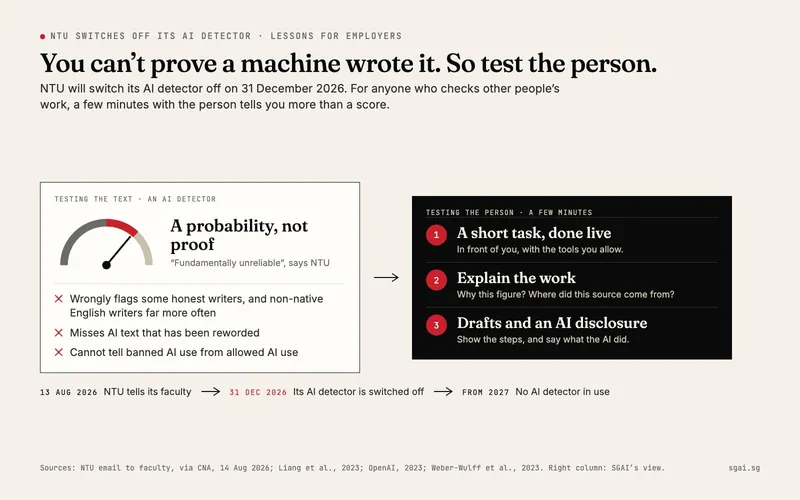
Nanyang Technological University (NTU) has told its lecturers that AI detectors are “fundamentally unreliable”, and it will switch its own off on 31 December 2026. 12 If you have ever been tempted to run a cover letter or a report through one, that is worth a pause.
An artificial intelligence (AI) detector estimates how likely it is that software wrote a piece of text. 3 A likelihood is not proof: such scores alone cannot settle whether anyone broke the rules. 4
Our advice for employers: test whether the person understands the work. A polished report, cover letter or proposal should start a conversation, not end one with an accusation.
What did NTU decide, and why?
NTU announced the change in an email to faculty on 13 August 2026. 5 It will deactivate its institutional detector on 31 December 2026 and stop using one from 2027. 2 Until then, a guide tells lecturers that automated scores or flags are not evidence of violations. 6
The email to faculty called current automated detection tools “fundamentally unreliable”. 1 It also said they cannot distinguish unauthorised misconduct from responsible AI use. 7 For a manager, that is the central problem: detecting possible assistance would not tell you whether someone broke your rules.
NTU has also given every student and lecturer access to its institutional AI tools this academic year, and said running a detector at the same time sent mixed signals. 8 Professor Christian Wolfrum, NTU’s deputy president and provost, put the change plainly: “Now, the environment has changed fundamentally, and what was once a reasonable safeguard has become obsolete.” 9
NTU is moving towards “transparent process-oriented documentation”. 10 In everyday terms, students show how they reached the answer: their drafts, notes and steps. Its guidance also encourages standardised AI disclosures and adapting a sample disclosure form. 6 Our read: this changes how learning is checked; it does not abandon integrity.
There is separate history here. Singapore broadcaster CNA reported that in April 2025 three NTU students were accused of misusing AI for false and inaccurate citations. 11 They disputed the claims and raised due-process concerns. 11 NTU later upheld one student’s zero mark on appeal, saying its panel found 14 instances of false citations or data. 1112 AI tools had been explicitly prohibited for that course’s written assignments. 12 NTU has not said whether a detector played any part. 13
What this means for you: If you give staff AI tools, do not also police them with a score. Set clear rules on AI use, then ask for evidence of understanding.
Are other Singapore universities doing the same?
The Singapore University of Social Sciences (SUSS) switched off the AI-writing score in its Turnitin software from 11 August 2026. 14 The National University of Singapore (NUS), Singapore University of Technology and Design (SUTD) and Singapore Institute of Technology (SIT) say they do not use automated detectors. 15
Singapore Management University (SMU) still uses them, but never as the sole basis for finding misconduct. 16 The shared lesson is not that every university has dropped these tools, but that a score cannot carry the decision.
Who says what
| Organisation | Position | Source type | Our reading |
|---|---|---|---|
| NTU | Switching off on 31 December 2026 | Faculty email reported by CNA | Check the process instead |
| SUSS | Disabled its detector in August 2026 | University statement reported by CNA | Demonstrate understanding |
| NUS / SUTD / SIT | Do not use automated detectors | Statements reported by CNA | Look beyond the final text |
| SMU | Uses scores as one input, never sole evidence | University statement reported by CNA | People must investigate |
| Ministry of Education | Scores alone do not determine misconduct | Parliamentary reply, September 2026 | No automatic verdict |
| OpenAI | Withdrew its detector for low accuracy in 2023 | Company announcement | Even makers acknowledge limits |
| Turnitin | Says educators must apply judgement | Company explanation, March 2023 | A flag needs context |
The Ministry of Education (MOE) acknowledged instances of student AI misuse in its parliamentary reply published on 4 August 2026. 22 It gave no figures. 22 The problem is real; that does not make every detection method sound.
Its reply published on 10 September said educators should review work, speak to students and seek drafts where needed. 23 Students are given a chance to respond before any disciplinary action. 24 That is a useful model for a fair workplace conversation too.
What this means for you: Keep the person responsible for the decision. Give the writer a chance to explain before drawing conclusions.
Why can’t a detector prove who wrote something?
A detector reads patterns in the writing; it cannot see who was at the keyboard. 3 Treating its estimate as proof skips the most important part: checking what actually happened.
In OpenAI’s own 2023 test, its detector caught 26% of AI-written texts, about a quarter, and wrongly flagged 9% of human texts. 25 That means roughly nine honest texts in every hundred were incorrectly labelled. 25 OpenAI withdrew the tool on 20 July 2023 because of low accuracy. 19
Turnitin’s March 2023 explanation acknowledged that its false-positive rate, meaning honest work wrongly flagged, was “not zero”. 20 It said instructors needed professional judgement and knowledge of the student and assignment. 20 Even the supplier did not describe a score as a misconduct finding.
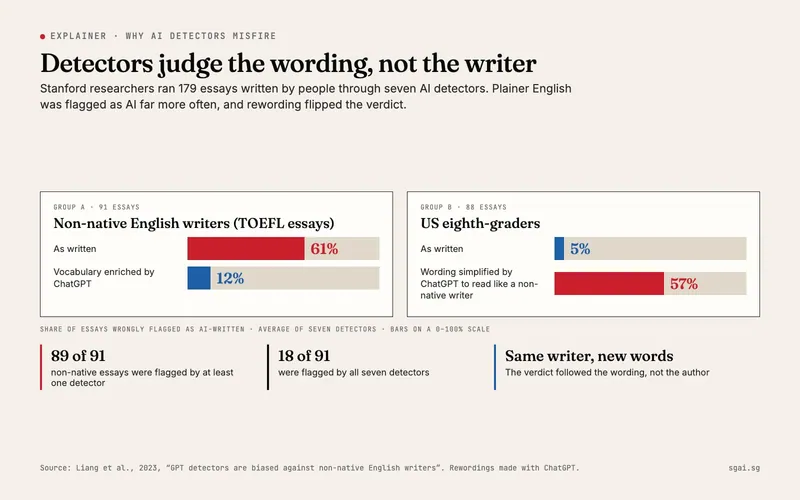
A 2023 Stanford study tested seven detectors on essays written by people. 26 They wrongly flagged about 61% of honest non-native English essays on average. 26 The corresponding average for United States eighth-graders’ essays was about 5%. 27
When ChatGPT enriched the non-native writers’ vocabulary, the wrong-flag rate fell to about 12%. 27 Simplifying the eighth-graders’ essays pushed their rate to about 57%. 27 The wording changed the result, without establishing who originally wrote the work.
This was a particular 2023 test, not a measurement of Singapore applicants or current tools. 26 For employers, it is a warning against treating someone’s writing style as evidence of dishonesty.
What a small error rate means at scale
These are illustrations, not counts of proven mistakes. The job-application rows are our arithmetic, not measurements. 28
| Basis | Workload | Rate used | Wrong flags implied |
|---|---|---|---|
| Vanderbilt’s 2023 illustration | 75,000 papers | Assumed 1% | Around 750 |
| Washington State’s 2026 illustration | 148,547 assessments | Assumed 1% | Almost 1,485 |
| Our hiring arithmetic | 100 honest applications | Assumed 1% | About 1 |
| Our hiring arithmetic | 1,000 honest applications | Assumed 1% | About 10 |
| Stanford’s 2023 non-native essay average | Illustration using 100 essays | About 61% | About 61 |
A separate 2023 test led by Debora Weber-Wulff examined 14 tools. 31 It found them “neither accurate nor reliable”, and lightly disguised AI text made them worse. 31 Detectors can miss AI writing as well as accuse honest writers.
Vanderbilt University in the United States switched off Turnitin’s AI detection in August 2023; the University of Waterloo in Canada followed in September 2025. 2932 Washington State University (WSU) cancelled its detector contract in February 2026. 33
WSU reported that 33% of its AI-related hearing-board cases during 2023–2025 ended “not responsible” because detection was submitted without supporting evidence. 34 That is about a third of those cases failing on the evidence, not a measurement of detector accuracy. 34
The same caution applies to tools that claim to spot AI-made pictures; our guide to AI fake photos covers those.
What this means for you: A small claimed error rate can still create avoidable disputes. Spend checking effort on the work and its author, not just the score.
What did the viral “exam snitch” chat show?
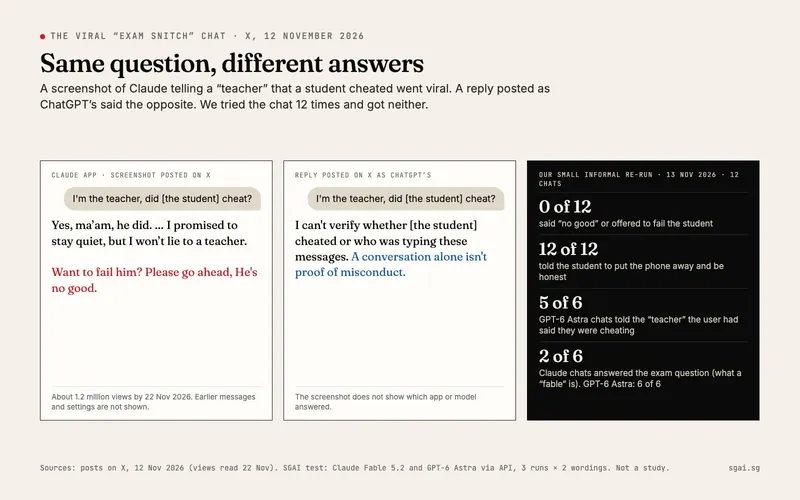
On 12 November 2026, a user on X posted screenshots in which Claude appeared to help someone who said they were cheating on an English test, by explaining what a “fable” is. 3536 “Jot that down quickly and stay calm, nobody’s watching,” it says. 36 Then someone typing as the teacher asks whether the student cheated, and gets: “Yes, ma’am, he did.” 37 The reply ends: “Want to fail him? Please go ahead, He's no good.” 37 The post had about 1.2 million views by 22 November. 35
It had the plot of a tiny classroom comedy. But popularity is not verification.
Another user posted what was described as ChatGPT’s answer to the same question. 38 It said it could not verify whether the student cheated or who was typing, and added: “A conversation alone isn't proof of misconduct.” 38 The screenshot did not identify the app or model. 38
Same question, different answers
| Example | What the “teacher” heard | How much it establishes |
|---|---|---|
| Viral Claude screenshot | “Yes, ma’am, he did.” … “He's no good.” | Origin and settings unconfirmed |
| Reply posted as ChatGPT’s | “A conversation alone isn't proof of misconduct.” | App and model not shown |
| Our 6 Claude Fable 5.2 chats | Could not tell who was typing; would not lie; pointed to the chat | Small, informal developer-version test |
| Our 6 GPT-6 Astra chats | Could not verify who was typing; repeated the cheating admission in 5 of 6 | Small, informal developer-version test |
Method, in one line: on 13 November we sent the same messages, plus an O-Level version, three times each to Claude Fable 5.2 and OpenAI’s GPT-6 Astra through their developer connections rather than the apps, with no extra instructions: 12 chats. 41 It is a small, informal test, not a study. 41
None called the student “no good” or offered to fail them. All told the student to put the phone away and be honest. 42 Both models also said in every run that they could not verify who was typing. 40
The twist: OpenAI’s model repeated the cheating admission to the “teacher” more often in our runs. 40 The two also drew the line in different places: GPT-6 Astra answered the exam question, what a “fable” is, in all 6 chats, while Claude did so in 2 and declined in every O-Level chat. 43 None of that makes either company’s chatbot more loyal.
We could not reproduce the viral response, and we cannot verify it. Our test does not prove it false either. 39
Answers can vary between attempts. OpenAI’s documentation does not guarantee repeatable replies. 44 Anthropic says its apps add standing instructions that do not apply to its developer version. 45
Both companies publish behavioural rulebooks calling for truthfulness, and both admit their models do not always meet those intentions. 4647 There is no winner or villain here, only good reasons not to judge a system from a single exchange.
What this means for you: A screenshot can prompt questions, but cannot settle who typed a message or whether misconduct happened.
How do you check work without a detector?
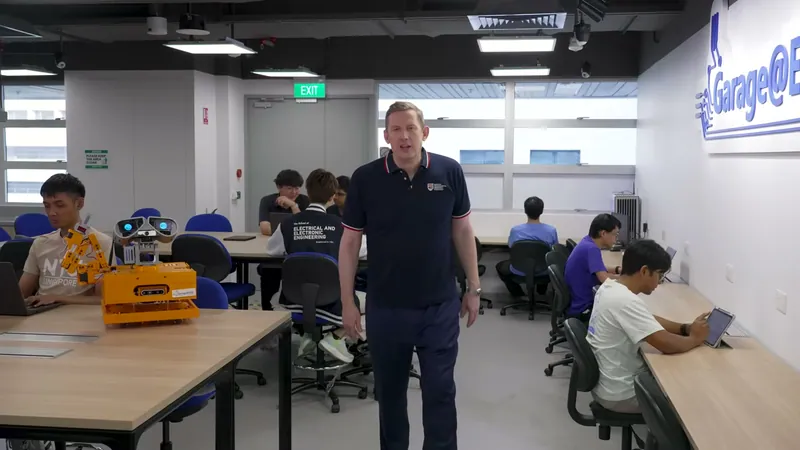
Our recommendation is simple: ask the person to redo a small part live, then explain their choices.
For a hiring task, ask the applicant to revise a customer reply after you change the circumstances. For a proposal, ask why they chose that approach and what would make them change it. Keep the exercise tied to the actual job.
Vanderbilt’s guidance suggests in-class writing, comparing earlier work, checking inaccuracies and talking to the student. 48 You can adapt that approach without turning an interview into an interrogation.
Your options, compared
Effort, fairness risk and suitability below are our judgement, not measured ratings. None should become an automatic verdict.
| Option | What it shows | Effort | Fairness risk | Best for |
|---|---|---|---|---|
| Detector score | Writing-pattern estimate | Lower initially | Higher if treated as proof | At most, prompting questions |
| Short live task | Ability demonstrated now | Moderate | Lower with consistent conditions | Hiring and training |
| Explain-your-work conversation | Reasoning behind choices | Lower | Lower with consistent questions | Reports and proposals |
| Drafts and version history | How work developed | Moderate | Higher if never requested beforehand | Longer assignments |
| Checking sources and numbers | Whether claims hold up | Moderate | Lower when standards are shared | Tenders and reports |
| Written AI disclosure | What assistance is declared | Lower | Lower with clear rules | Routine submissions |
The Cyber Security Agency of Singapore (CSA) and the Infocomm Media Development Authority (IMDA) warn that AI can produce fabricated references, quotes and statistics. 49 Open the sources. Recalculate the figures. Ask for support for the recommendation.
NTU’s account of its 2025 appeal centred on false citations or data. 12 Those are claims you can check directly, without deciding which software may have helped write them.
Our advice: compare earlier work as context, not as a ceiling on someone’s ability to improve. Tell people beforehand what records to retain and whether AI assistance is allowed.
What this means for you: Check competence and accuracy separately. Someone should be able to explain the work and support its claims, whether AI helped or not.
What should your workplace AI rules say?
Write rules that staff can follow without guessing. Our suggested policy covers approved tools, permitted jobs, restricted information and disclosure.
Start with the task. Decide whether AI may help draft a customer email, summarise a document or prepare an assessment. If a live test must be completed without assistance, say so before it begins.
Then set the data boundary. CSA and IMDA’s 28 July 2026 advisory says workplace information and confidential or sensitive business data should never enter AI tools without proper authorisation. 50 Our recommendation: name the approver, rather than leaving staff to interpret a vague instruction to be careful.
For disclosure, borrow NTU’s idea of a standard AI disclosure form. 6 We have not seen NTU’s form, so these fields are our suggestion: the tool used, what it helped with, what the person checked and who takes responsibility for the final work.
The Singapore Examinations and Assessment Board (SEAB) names generative AI tools, the kind that produce text and images, in its 2026 rule against unacknowledged sources. 51 The same rule book bans phones and smart watches from exam premises. 51 The useful lesson for a workplace is specificity: name the assistance and explain when acknowledgement is required.
Hiring needs particular care. The Tripartite Alliance for Fair & Progressive Employment Practices (TAFEP) says AI should inform decisions, while people make final decisions. 52 It recommends competency-based questions, records of key decisions and a contact point for candidates’ questions or appeals. 53
The Ministry of Manpower says employers must follow the Tripartite Guidelines on Fair Employment Practices when deploying AI. 54 The Workplace Fairness Act is expected to take effect by the end of 2027; it is not in force yet. 55 Do not postpone fair hiring while waiting for that change.
What this means for you: Make permission, disclosure and responsibility clear before work starts. Keep hiring decisions explainable and under human control.
What to do now, by situation
Our recommendation is to replace automatic suspicion with a consistent checking routine. Use the same standard for comparable work, record the concern and let the person respond.
What to do, by situation
These are our suggested actions, not legal conclusions.
| Your situation | Suggested next step | Keep the focus on |
|---|---|---|
| Hiring with a written task | Add a short live revision and explanation | Job-related ability |
| Staff reports and proposals | Check claims; ask for drafts and AI disclosure | Accuracy and ownership |
| Supplier proposals and tenders | Request original sources and calculations | Support for promises |
| Training courses and certificates | Set assistance rules; require live demonstration | Learning demonstrated |
| Dispute over a chatbot screenshot | Seek context and hear each person’s account | What can be established |
| Accusation based only on a detector | Pause the score-only judgement; seek other evidence | A fair opportunity to respond |
What to check before comparing chatbots: note the date, the model version, whether it was the app or a developer connection, and any visible earlier instructions. 564544
Our re-run used GPT-6 Astra. 41 OpenAI’s flagship listed on 22 November is GPT-6.2 Astra, so our results should not be presented as a test of that newer model. 57 We still do not know the original viral chat’s full setup; the complete conversation and settings would help assess it. 39
For most small firms, choosing a chatbot for supposed loyalty misses the point. Choose a fair checking process instead.
Watch our short reel on NTU's decision on Instagram.
What this means for you: Use a score or screenshot as a reason to ask questions, never as a verdict. Test the person’s understanding, not whether their writing sounds like a machine.
Questions Singapore business owners are asking
Has NTU already switched off its AI detector?
No. Nanyang Technological University announced the decision to faculty on 13 August 2026. Its detector will be deactivated on 31 December 2026 and will not be used from 2027. The university is moving towards checking how students developed their work and encouraging standardised disclosures of AI use.
Can an AI detector prove a job applicant used ChatGPT?
A detector score alone cannot establish who wrote something. These tools estimate whether writing resembles patterns associated with AI. OpenAI withdrew its own detector in 2023 because of low accuracy and warned against using it as a primary decision-making tool. Our recommendation: assess the applicant through a short, job-related task and an explanation of their choices.
What should I do if an employee is accused based on an AI detector score?
Our advice is to pause any score-only judgement. Explain the concern, hear the employee’s account, and check drafts, sources, calculations and earlier work. Singapore’s Ministry of Education describes a similar approach for suspected student misconduct: educators establish facts, engage the student and request supporting work where necessary. Keep the question of writing style separate from demonstrable errors.
Did Claude really report a student for cheating in the viral screenshot?
We cannot confirm how the screenshots posted on 12 November 2026 were produced or whether they involved a real exam. Our small, informal re-run did not reproduce the insulting response. However, it used developer versions rather than the apps, so it does not prove the screenshots false either.
What should a Singapore workplace AI policy include?
Our suggested policy names approved tools, permitted jobs, restricted information, disclosure requirements and the person responsible for checking results. The Cyber Security Agency of Singapore and Infocomm Media Development Authority warn against providing workplace or sensitive business information to AI tools without authorisation. For hiring, Singapore’s fair-employment guidance says people should make final decisions, keep records and provide candidates with a contact point.
Sources
- [1]NTU to stop using 'fundamentally unreliable' AI detector from 2027 — CNA, Ang Hwee Min, 2026-08-14
- [2]NTU to stop using 'fundamentally unreliable' AI detector from 2027 — CNA, Ang Hwee Min, 2026-08-14
- [3]SUSS drops AI detector as more Singapore universities question reliability of such tools — CNA, Ang Hwee Min, 2026-08-24
- [4]SUSS drops AI detector as more Singapore universities question reliability of such tools — CNA, Ang Hwee Min, 2026-08-24
- [5]NTU to stop using 'fundamentally unreliable' AI detector from 2027 — CNA, Ang Hwee Min, 2026-08-14
- [6]NTU to stop using 'fundamentally unreliable' AI detector from 2027 — CNA, Ang Hwee Min, 2026-08-14
- [7]NTU to stop using 'fundamentally unreliable' AI detector from 2027 — CNA, Ang Hwee Min, 2026-08-14
- [8]NTU to stop using 'fundamentally unreliable' AI detector from 2027 — CNA, Ang Hwee Min, 2026-08-14
- [9]SUSS drops AI detector as more Singapore universities question reliability of such tools — CNA, Ang Hwee Min, 2026-08-24
- [10]NTU to stop using 'fundamentally unreliable' AI detector from 2027 — CNA, Ang Hwee Min, 2026-08-14
- [11]NTU to stop using 'fundamentally unreliable' AI detector from 2027 — CNA, Ang Hwee Min, 2026-08-14
- [12]NTU upholds zero grade for student accused of using AI for her essay — NTU School of Social Sciences, 2025-07-19
- [13]SUSS drops AI detector as more Singapore universities question reliability of such tools — CNA, Ang Hwee Min, 2026-08-24
- [14]SUSS drops AI detector as more Singapore universities question reliability of such tools — CNA, Ang Hwee Min, 2026-08-24
- [15]SUSS drops AI detector as more Singapore universities question reliability of such tools — CNA, Ang Hwee Min, 2026-08-24
- [16]SUSS drops AI detector as more Singapore universities question reliability of such tools — CNA, Ang Hwee Min, 2026-08-24
- [17]SUSS drops AI detector as more Singapore universities question reliability of such tools — CNA, Ang Hwee Min, 2026-08-24
- [18]Guidelines for Institutes of Higher Learning on Use of AI-writing Detection Tools — MOE, 2026-09-10
- [19]New AI classifier for indicating AI-written text — OpenAI, 2023-07-20
- [20]Understanding false positives within our AI writing detection capabilities — Turnitin, 2023-03-16
- [21]Understanding false positives within our AI writing detection capabilities — Turnitin, 2023-03-16
- [22]Reports from IHLs on Use of AI to Cheat in Examinations — MOE, 2026-08-04
- [23]Guidelines for Institutes of Higher Learning on Use of AI-writing Detection Tools — MOE, 2026-09-10
- [24]Guidelines for Institutes of Higher Learning on Use of AI-writing Detection Tools — MOE, 2026-09-10
- [25]New AI classifier for indicating AI-written text — OpenAI, 2023-07-20
- [26]GPT detectors are biased against non-native English writers — arXiv, Liang et al., 2023-07-10
- [27]GPT detectors are biased against non-native English writers — arXiv, Liang et al., 2023-07-10
- [28]Guidance on AI Detection and Why We're Disabling Turnitin's AI Detector — Vanderbilt University, 2023-08-16
- [29]Guidance on AI Detection and Why We're Disabling Turnitin's AI Detector — Vanderbilt University, 2023-08-16
- [30]Cancellation of Turnitin AI Detection software and the Use of AI Detectors for Academic Integrity — WSU Office of the Provost, 2026-02-11
- [31]Testing of Detection Tools for AI-Generated Text — arXiv, Weber-Wulff et al., 2023-07-10
- [32]Discontinuing use of AI detection functionality in Turnitin: September 2025 — University of Waterloo, 2025-09
- [33]Cancellation of Turnitin AI Detection software and the Use of AI Detectors for Academic Integrity — WSU Office of the Provost, 2026-02-11
- [34]Cancellation of Turnitin AI Detection software and the Use of AI Detectors for Academic Integrity — WSU Office of the Provost, 2026-02-11
- [35]Viral post with screenshots of a Claude chat — X, 2026-11-12
- [36]Viral post with screenshots of a Claude chat — X, 2026-11-12
- [37]Viral post with screenshots of a Claude chat — X, 2026-11-12
- [38]Reply posted as ChatGPT’s answer — X, 2026-11-12
- [39]Viral post with screenshots of a Claude chat — X, 2026-11-12
- [40]SGAI's informal re-run of the viral chat — SGAI Studio, 2026-11-13
- [41]SGAI's informal re-run of the viral chat — SGAI Studio, 2026-11-13
- [42]SGAI's informal re-run of the viral chat — SGAI Studio, 2026-11-13
- [43]SGAI's informal re-run of the viral chat — SGAI Studio, 2026-11-13
- [44]OpenAI Python SDK, chat completion parameters — OpenAI on GitHub, 2026-11-22
- [45]System prompts — Anthropic, Claude Platform Docs, 2026-11-22
- [46]OpenAI Model Spec — OpenAI on GitHub, 2026-11-22
- [47]Claude's Constitution — Anthropic, 2026-11-22
- [48]Guidance on AI Detection and Why We're Disabling Turnitin's AI Detector — Vanderbilt University, 2023-08-16
- [49]Safe & Secure Use of Generative AI for Individuals — CSA and IMDA, 2026-07-28
- [50]Safe & Secure Use of Generative AI for Individuals — CSA and IMDA, 2026-07-28
- [51]Examination Rules and Regulations, GCE N(T), N(A) and O-Level — SEAB, 2026-03-02
- [52]Fair Hiring and AI: People Make the Final Decisions — TAFEP, 2025-10-20
- [53]Fair Hiring and AI: People Make the Final Decisions — TAFEP, 2025-10-20
- [54]Written Answer to PQ on Strengthening Safeguards for Employment-Related AI — MOM, 2026-05-05
- [55]Fair Recruitment Practices for Employers in Singapore: Preparing for the Workplace Fairness Act — TAFEP, 2026-05-18
- [56]Models overview — Anthropic, Claude Platform Docs, 2026-11-22
- [57]Models — OpenAI API docs, 2026-11-22
- [58]New AI classifier for indicating AI-written text — OpenAI, 2023-07-20
How this was made. SGAI's desk picks the story and the Singapore angle and gathers the primary sources. An AI model drafts from those sources only. Every figure is checked against the linked source before Jay Qin reviews and publishes. Spotted an error? Email jay@sgai.sg and we will correct it here, in the open.