Digital asset or digital investment? A test for every marketing dollar
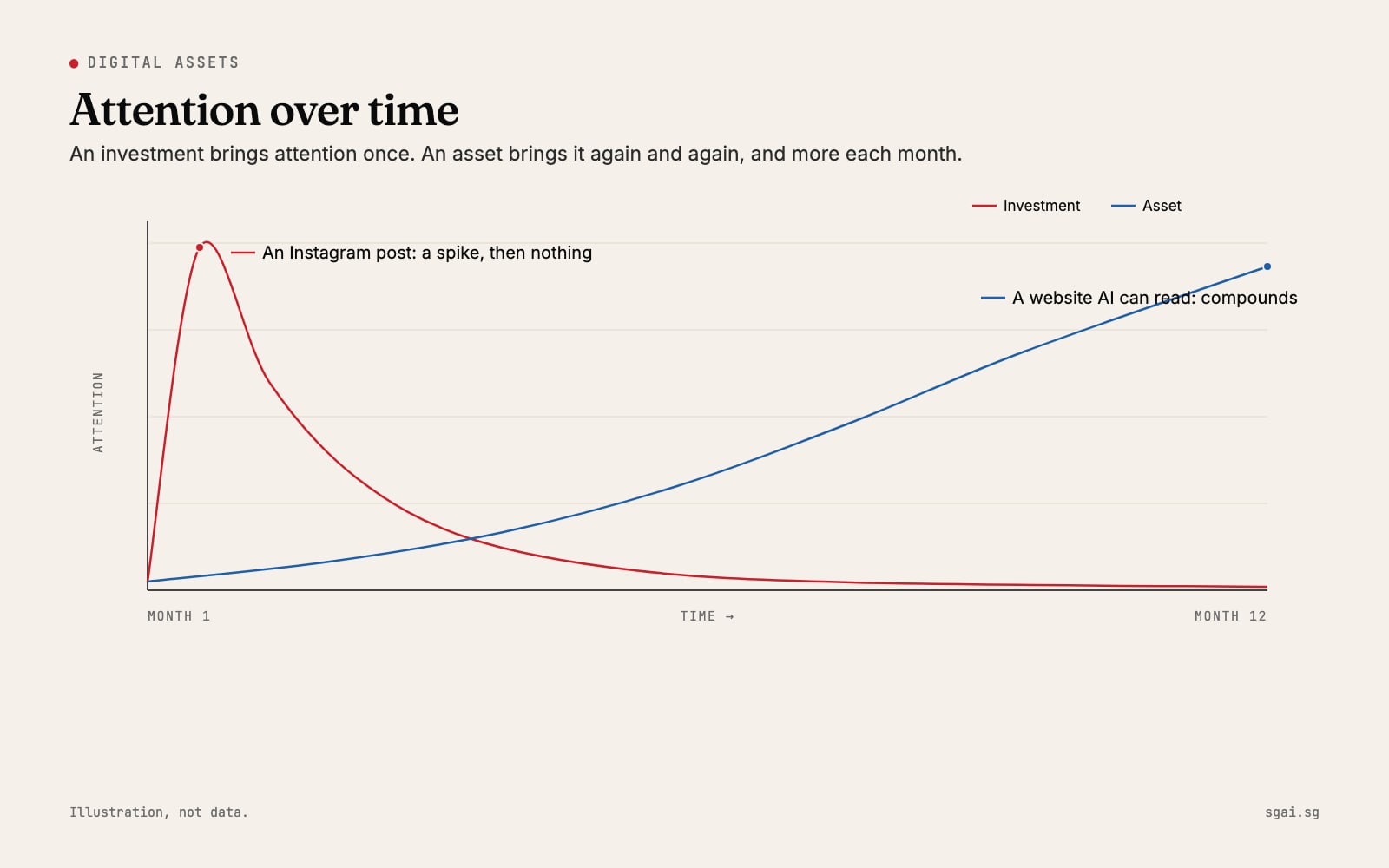
You already know what an asset is. Your parents may have bought a shophouse decades ago, and it has paid rent ever since. Nobody had to buy it again each month. Online, most businesses spend as if they are buying assets, and end up holding something that stops paying the week after it goes up. One simple test tells the two apart.

The definition
An asset pays you again and again. That is what separates it from an expense. You pay once, and the return keeps coming.
A digital asset works the same way, except what it brings is attention. A digital asset brings attention again and again: visitors, enquiries, mentions, recommendations, week after week, without you paying for each one.
Anything that does not do that yet is not an asset. It is an investment. You have put money in and you are hoping it turns into an asset. Some do. Most do not.
The consistency test
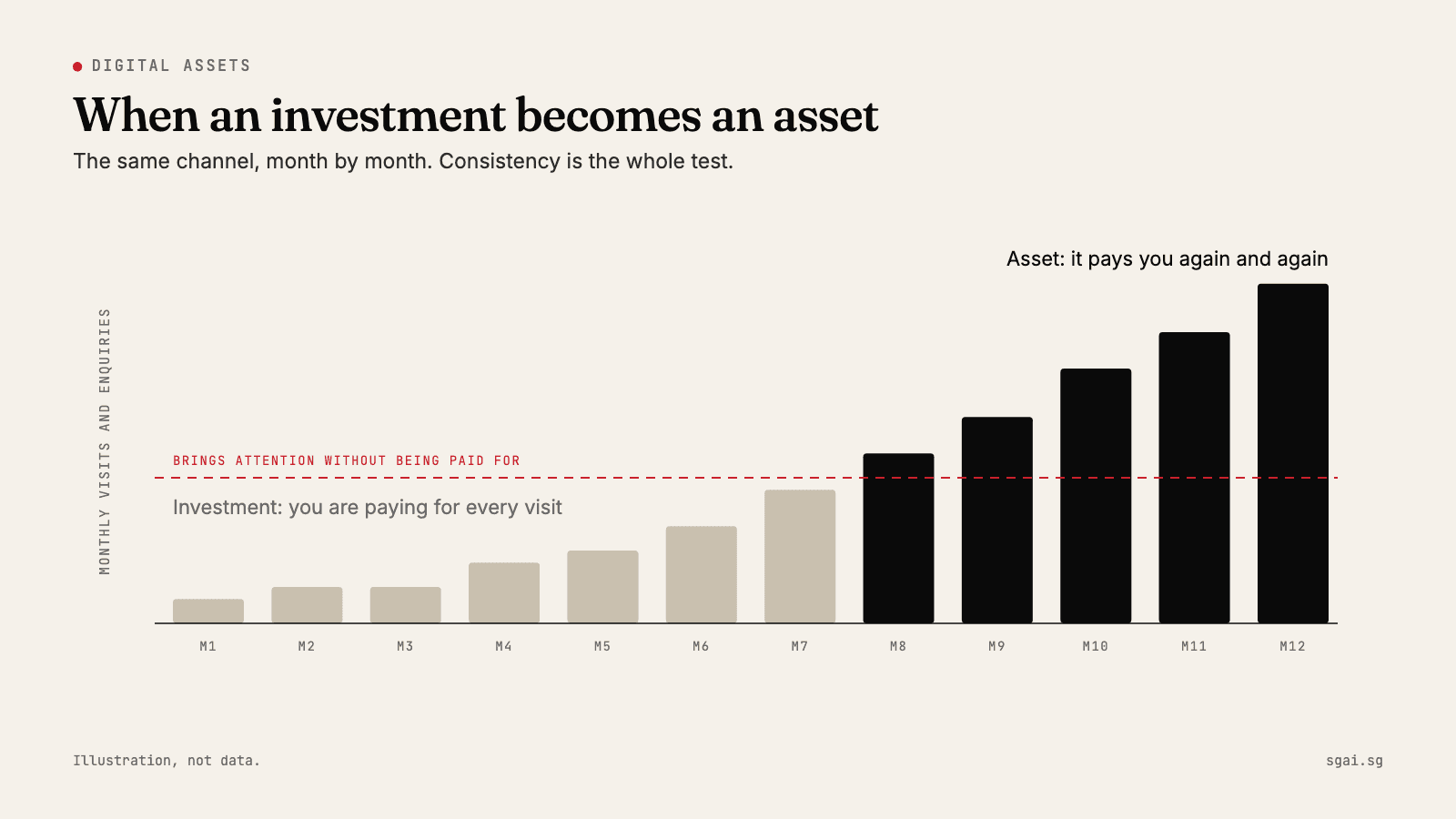
The keyword is consistency. Ask three questions of anything you spend on online.
- Does the attention keep coming? Not a spike in the first three days, but a steady flow months later.
- Does the content keep coming? An asset is maintained. A page or channel that stopped in 2019 is decaying, not compounding.
- Does the next piece build on the last? In an asset, each new article, video or page makes the whole stronger. In an investment, each piece starts from zero.
If the answer to all three is yes, you have an asset. If not, you have an investment that has not paid back yet.
| Investment | Asset | |
|---|---|---|
| Attention | A spike, then nothing | Keeps arriving every week |
| What you pay | Every time, for every piece | Mostly once, then upkeep |
| Next piece | Starts from zero | Builds on what is there |
| Who can read it | Mostly people scrolling | People, search engines and AI assistants |
| Example | A one-off video with no following behind it | A website AI reads and cites; a channel that brings traffic every week |
Why most Instagram posts fail the test
Here is the usual story. A business decides it needs to be online and goes straight to Instagram. A video goes up. Traffic comes for three days, then nothing, and nobody knows why. The next video gets a thousand views. It feels good. Then it stops again.
Nothing was being built. Each video was paid for once and paid back for three days. Until the channel brings traffic every week, every video is an investment, and most never pay back.
There is a second problem. AI assistants do not watch your Instagram. Even if they did, there would be little there for them to keep: no clear statement of what you do, no address, no list of products, no proof, no history. They take all of that from a website.
Think of it this way. Instagram is the cap you wear on a Monday. Your website is your identity card. People notice the cap. But when anyone, or anything, needs to check who you are, they ask for the card.
None of this means social media is useless. A channel that consistently brings traffic is an asset. The point is the order: the cap only makes sense once you have the card.
Why most AI-generated content fails it too
Cheap AI content is the newest version of the same mistake. It is now easy to publish fifty blog posts a week, written by a machine about nothing in particular. Each one costs almost nothing. Together they build almost nothing, because they say what every other machine-written post says.
People can tell. And content people can tell is AI is content people skip. That is not a theory for us. It is the first lesson we learned.
What we learned in 2022, before ChatGPT
In 2022 I was a trader on Wall Street. The head of the desk told me to look into OpenAI. Its models made things up constantly back then, and the best image models were Midjourney and DALL·E, which could not draw a readable sign. I spent my weekends building with them anyway.
The result was the Artificial News Network (checked 8 Nov 2026), an always-on pipeline. A headline crossed the Bloomberg Terminal on my desk. I typed it into iMessage on my phone. A MacBook that never slept was watching that chat. A small script picked up the line, sent it to OpenAI to turn into a scene and a caption, sent the scene to an image model, and posted the result to Instagram while the news was still breaking. After that first message, nobody touched a keyboard.
It worked as a machine. It taught me something more important as a business. The early posts had signs nobody could read and faces nobody would trust. People could tell it was AI, and they scrolled past. The content that works is so useful that nobody minds a machine helped.
That lesson became the idea behind SGAI: cheap compute, your knowledge. Computing power is now cheap and getting cheaper. On its own, it produces content that looks like everyone else's. Multiplied by what your business actually knows, the projects, the judgement, the twenty years of doing it properly, it produces something nobody else can. That is how cheap compute turns into an asset instead of noise.
Why a website AI can read passes the test
A good website is the clearest example of a digital asset most businesses can own.
- The attention keeps coming. A page that answers a real question, written in the words buyers use, keeps being found in search month after month.
- It is read by machines, not just people. AI assistants build their answers from text they can read and check. A clear website with your facts, your proof and your services is exactly what they need. Google publishes its own guidance on creating helpful, reliable, people-first content (checked 8 Nov 2026), and the principle is the same for assistants.
- Each page builds on the last. A new project page strengthens the services page, which strengthens the home page. The site gets more useful with every addition.
- You own it. The domain, the code and the content belong to you, not to a platform that can change its rules.
But only if AI can read it. A website AI cannot read is not a digital asset. If your services are in a PDF, your proof is in photos of certificates and your text only appears after code runs, the machine sees very little. In that case the website is costing you money and returning almost nothing. We go through the common reasons in why ChatGPT doesn't know your company.
The order of operations
If you only remember one thing, remember the order. Being found and recommended is built in five layers, and most companies only ever build the last one, the part people see.
- Website. Secure, fast, on current technology, and in your company's name. Start here, because the website is how you work out your positioning.
- Positioning. What you are known for, for whom, and what you do not do. Writing the website forces this decision.
- SEO. Your positioning written in the words buyers type. It is not dead. It became the baseline.
- AI discovery. Facts and proof that assistants can read and check, so they can recommend you with confidence.
- Content and media. Articles, photography and video. The part people see, and the part that finally compounds because the base is in place.
Start with content and you are buying caps. Start with the website and every dollar you spend later has somewhere to land.
A test for your next marketing dollar
Before you approve the next spend, ask:
- Will this still bring attention six months from now?
- Will it be readable by search engines and AI assistants, not only by people scrolling?
- Does it build on something we already own, or does it start from zero?
- Does it say something only our business could say?
- Is it in our company's name, on something we control?
Three or more "no" answers means it is an investment, not an asset. That is fine if you know it. The trouble starts when a business spends years buying investments and calling them assets.
Our own channel, Asia Money Drama (checked 8 Nov 2026), produced by our publication Asia Succession Review, is how we hold ourselves to this test: real archive footage, researched scripts and professional narration, with each video building on the last. If you would like help turning what your business already knows into assets that keep paying, start with the website, and start a conversation with us.